

Описание
Страна : Великобритания
Год : 1942
Летающая лодка (проект)
Farnborough's Jet Flying Boat
Aeromilitaria 4-1998
Details of a RAE study into the feasibility of a jet-propelled fighter flying boat are contained in MAEE report H/Res/166.
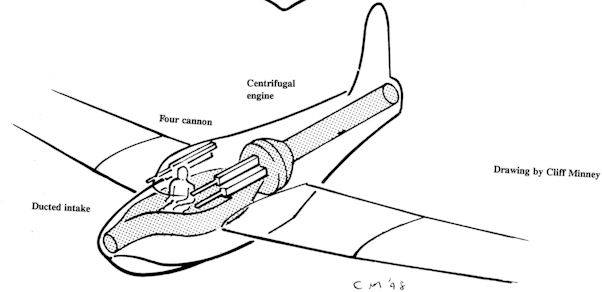
Events in the Pacific had resulted in a requirement for a fighter that was independent of airfields. Too many Allied aircraft had been caught sitting on the ground. Using a water-based fighter would mean that it could be flown from any suitable strip of water, probably an inlet where the aircraft could be camouflaged when not flying .
Specification N.2/42 was drawn up to cover a fighter with a retractable float as already flown in the larger Blackburn B.20 to Specification R.1/36. However, the idea of using a flying boat hull was investigated and a proposed design produced to meet the needs of N.2/42.
The aircraft would be armed with four 20mm cannon, have a maximum speed of 430 to 450 knots up to 20,000 feet and climb at 8,000 feet per minute at sea level and 4,700 at 20,000 feet.
Most drag on a boat was due to the high engine position necessary to give propeller clearance. In a jet, this could be avoided so the performance need be little inferior to an equivalent land-based aircraft. Due to the need for step and chines, the fuselage would have more drag but there would be no need for undercarriage doors.
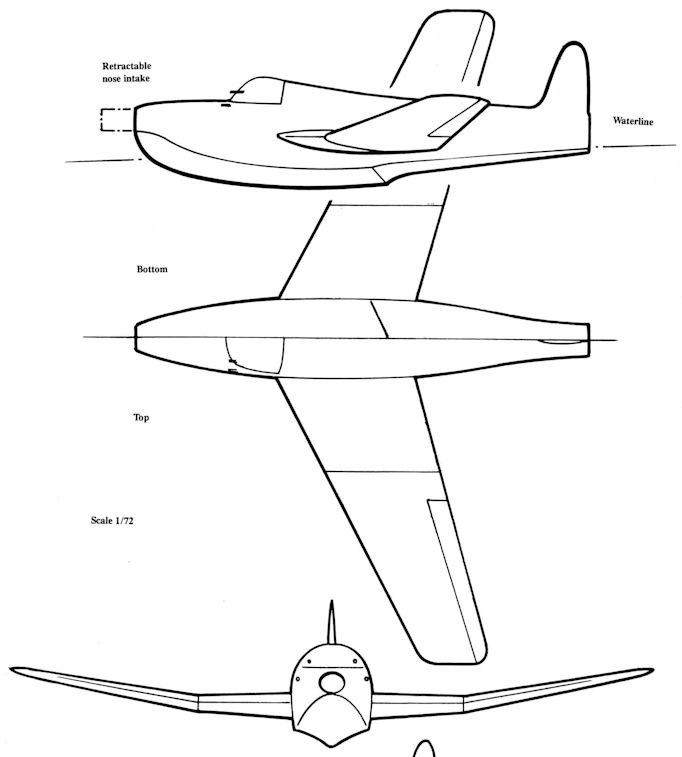
The design was based on the H.1 jet engine then under development. The engine was mounted in the hull, which had a height/beam ration of 6 for buoyancy purposes. It was difficult to provide orthodox horizontal tail surfaces as the hull was comparatively shallow. Longitudinal control was provided by wing-tip elevons. Flaps appeared to be unnecessary.
The wings were of NACA 66 section and free of cut-outs and excrescencies. The wing area was 254 sq ft with a wing loading of 25 Ib/sq ft. Without flaps, the landing speed was calculated to be 75 kts at a 5° approach angle of glide.
The wing was set well down the hull to act as a lateral stabiliser so no wing-tip floats were necessary. The elevons used 50% span and 20% chord.
The intake in the nose could be extended two feet forward for take-off to avoid spray. A water trap was necessary to prevent flooding of the jet exhaust on landing but the exhaust was well clear of solid water.
Although the design was not intended for production, it formed a basis for the later Saro A.1 fighter flying boat to Specification E.6/44 that first flew in July 1947.
- Farnborough's Jet Flying Boat
Фотографии
- Фотографии