

Описание
Страна : Великобритания
Год : 1939
(проект)
Flight, December 1941
THE GUARDIAN
A Light Civil Trainer with Some Novel Features : Tricycle Undercarriage and Side-by-side Seating
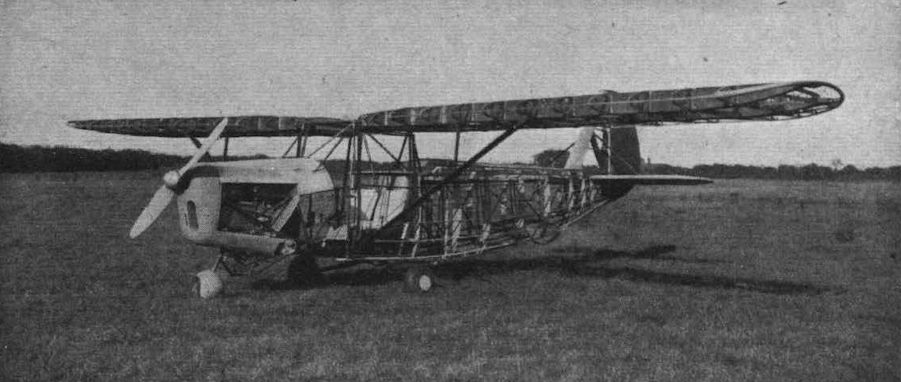
DETAILS have recently come to hand of an attractive little trainer, of which no description has previously been published. The machine, a high-wing cabin monoplane with a tricycle undercarriage, was designed by Mr. J. H. Payne. The construction of the prototype was nearing completion at Peterborough at the outbreak of the war. Intended chiefly for Civil Air Guard training, the machine was to be named, appropriately, the "Guardian."
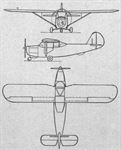
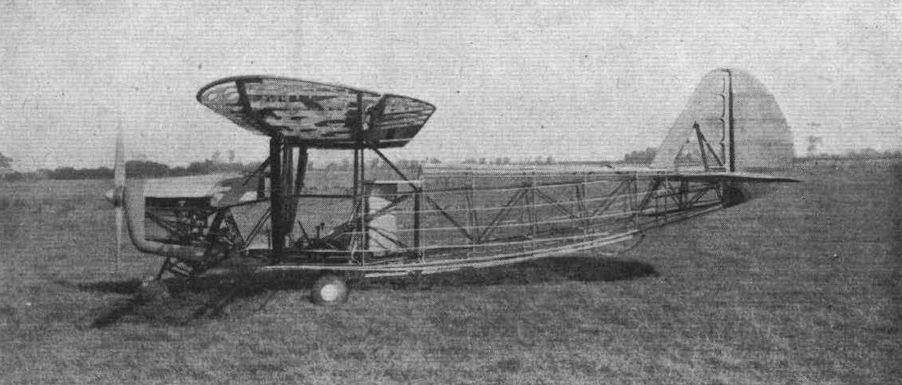
The machine was designed to full aerobatic factors. The three-view general arrangement drawings show the general layout, the photographs and sketches showing further details and the stage of construction reached.
The wings are rectangular in plan form, with rounded tips, and have a slight taper in thickness and local sweep-back of the leading edge at the inboard end. They are of wooden construction, having two parallel box-section spars connected by ribs and diagonal members. The leading edge, as far back as the front spar, is covered with stout pre-shaped plywood, the remainder of the wing being fabric covered. Both spars are pin-jointed at the root, and the wing is braced by a single strut attached to the front spar approximately half-way between the root and tip. The aerodynamic torque on the wing is taken internally, the necessary torsional stiffness being provided partly by the leading-edge box and partly by the system of diagonal bracing between the spars.
The ailerons, which have steel tubular spars but are otherwise of wooden construction, are aerodynamically and statically balanced. They occupy rather more than the outer half of each wing.
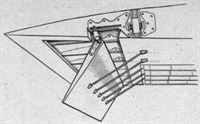
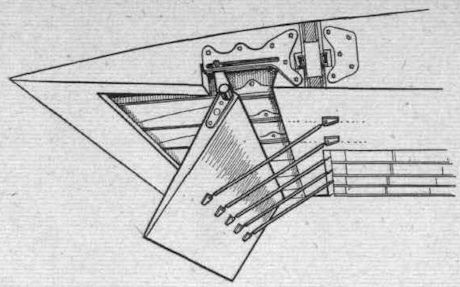
The inboard portions of the wings are provided with landing flaps, which are set forward from the trailing edge and let into recesses in the bottom surface of the wings. In order to reduce the operating loads the flaps are arranged to move backwards as they open.
With the exception of the elevator spar and rudder post, which are steel tubes, the tail unit is of wood. External bracing, in the form of a single strut on each side, connects the fin to the tailplane front spar. The tailplane and the leading edge of the fin are plywood covered. The rest of the tail unit is fabric covered. The incidence of the tailplane is adjustable on the ground.
The fuselage has a main structure of welded steel tubing and a light wooden fairing structure covered with fabric. Access to the cabin is provided by doors on both sides. The pilot and passenger, or instructor and pupil, sit side by side on "bucket" type seats, which are adjustable fore and aft. Full dual control is provided.
One of the problems always encountered when designing a small aircraft with side-by-side seating is that the legs of the crew tend to interfere with the lateral movement of the control column. In the Guardian this problem has been solved by the use of articulated control columns, i.e., only the upper portions hinge sideways. Organ-pedal type rudder controls are fitted, hinged below the heel.
Particular care has been paid to the design and positioning of the engine controls. The pupil, who sits in the left-hand seat, uses his left hand for the throttle. This throttle lever is roughly in line with the front edge of his seat, at such a height that it can be used without raising the arm. An interconnected lever is provided for the instructor in a similar position on the right-hand side of the cabin. The other controls - the brake lever and longitudinal trimmer - are placed centrally.
A full range of instruments is fitted, including turn-and-bank indicator, fore-and-aft level and compass.
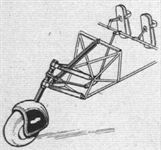
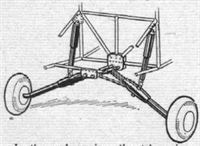
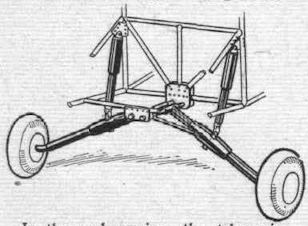
Undoubtedly the most interesting feature of the Guardian is the design of its tricycle undercarriage. The nose wheel is carried by a link mechanism, which enables the wheel to be placed well forward, under the "straight axle" is about. 10 deg., and the wheel is steered by push-rods interconnected with the rudder control pedals. The main undercarriage is of exceptionally "clean" design, the only external parts being the tubular axles carrying the low-pressure wheels.
The engine is the Cirrus "Minor," the well-tried four-cylinder in-line inverted unit developing 80-90 b.h.p. Dual fuel pumps are fitted drawing petrol from a 20-gallon tank in the fuselage, immediately behind the cabin.
The Guardian affords an interesting comparison with the Taylorcraft trainer, a description of which was published in our issue of December nth . Both have much in common with the ideal trainer which "Ex-R.F.C." discussed in his article in the October 2nd issue.
Leading dimensions :
Span 33ft 4in
Length 23ft 4in
Height 8ft 6in
Wing chord 5ft 0in
Wing area (nett) 146 sq.ft.
Weights
Tare weight 840lb.
All-up weight (acrobatic) 1,350lb.
Wing loading 9.25 lb./sq. ft.
Power loading 15 lb./h.p.
Performance (estimated):
Maximum speed 120 m.p.h.
Cruising speed 100 to 105 m.p.h.
Stalling speed (flaps down) 40 m.p.h.
Fuel consumption 3.5 to 4 gals, per hour.
Duration (approx.) 5 hours.
Range (approx.) 500 miles.
Rate of climb at G.L. 800ft./min.
Rate of climb at 10.000ft. 400 ft./min.
Service ceiling 14,000ft.
- Flight, December 1941
THE GUARDIAN
Фотографии
-
Flight 1941-12 / Flight
Work on this interesting light plane had to be postponed on the outbreak of war.
-
Flight 1941-12 / Flight
THE GUARDIAN IN SKELETON: The low ground clearance is partly due to the legs not being pumped up when the picture was taken.
-
Flight 1941-12 / Flight
The landing flaps are arranged to move backwards as they open, in order to reduce operating loads.
-
Flight 1941-12 / Flight
The nose wheel has a parallel-link motion and is linked to the rudder pedals for steering.
-
Flight 1941-12 / Flight
In the undercarriage the telescopic legs are inside the fuselage and are relieved of bending loads.
-


- Фотографии