

Описание
Страна : Великобритания
Год : 1942
(проект)
Air-Britain Aeromilitaria 4-2005
Professor Hill's Tailless Bomber
Professor G T R Hill was well known for his Pterodactyl series built by Westland. In the 1920s and 1930s, he was the main protagonist for flying wings. The Pterodactyl I was a light aircraft, followed by the Pterodactyl IV, which had a short fuselage with a cabin. In both cases, the pods were necessary to accommodate the pilot and engine as the wings were of insufficient depth to contain these.
The Mk.V was a two-seater fighter and had the crew and engine in a short fuselage. The lack of a tail assembly gave the gunner a wide field of fire. But performance was no better than the Demon already in service and it lacked the Demon's manoeuvrability.
There were later proposals including a flying boat and in 1942 Professor Hill produced a paper, dated 22nd July 1942, for a large tailless bomber.
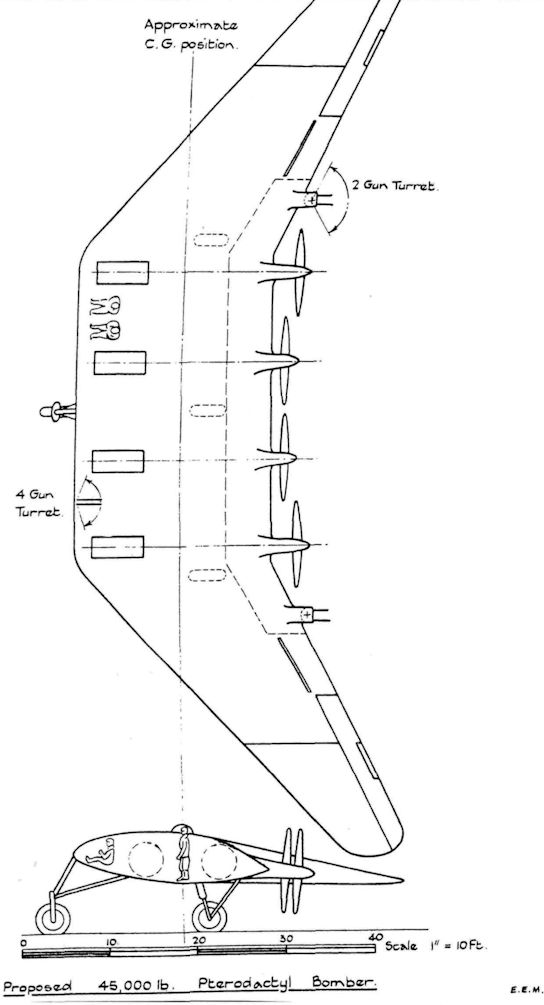
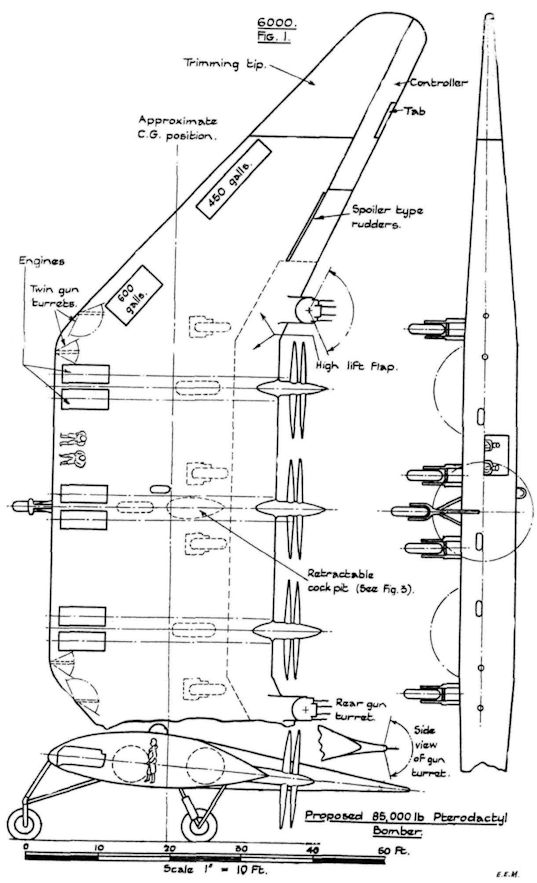
Weighing 85,000 lbs, it was based on earlier designs. The centre section was 7 ft 6 in deep, allowing the crew to move around easily and could also accommodate a pressure cabin. Wing span was 140 feet and the wing area 3,350 sq ft. There were no tail surfaces. The undercarriage had four main wheels and a nosewheel.
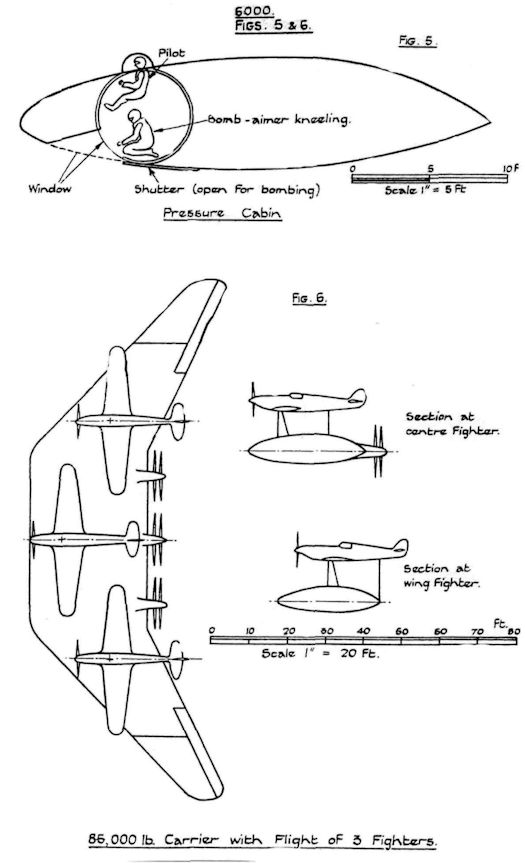
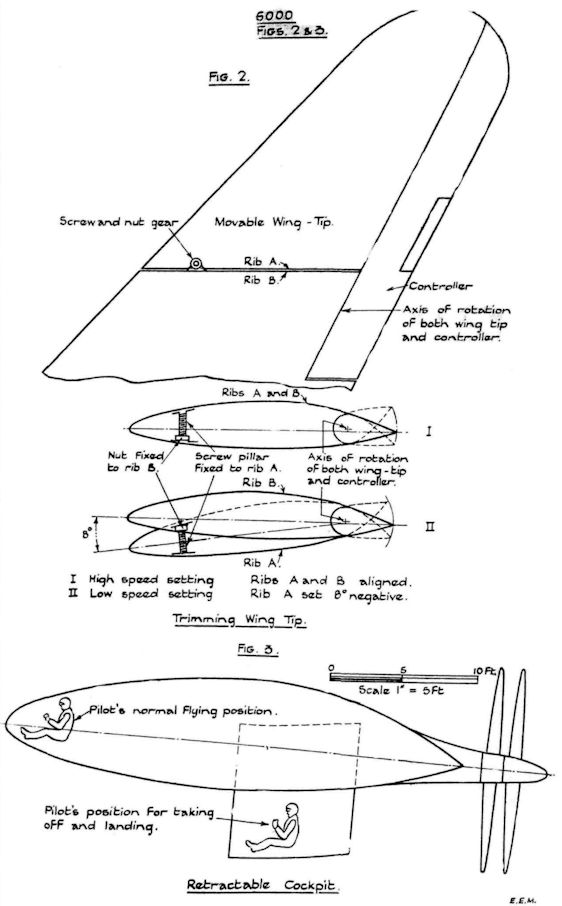
The pilot was seated inside the wing and an alternative position in a retractable dustbin was provided for take-off and landing. This could be lowered to give the pilot a clear view of the ground and the nosewheel gave him a directional aid. The navigator sat beside the pilot and could lie down to observe through transparencies on the underside of the wing.
Defensive armament would be provided by turrets directed by remote control, the controller being in a dome. A second controller with a downward view might also be necessary. Four-gun turrets were mounted at either end of the centre section to repel head-on attacks. Two more turrets were in the trailing edge of the wing clear of the propellers.
The bomb load was carried close to the centre of gravity. The engines were not specified but it was pointed out that jets could be fitted when development of these was sufficiently advanced. A smaller version was also planned for a weight of 45,000 lbs.
A final proposal was that the aircraft could be used as a carrier for three fighters, enabling them to be deployed at a much longer range than their fuel capacity would allow. They could be carried to a point where fighter cover was required, for example to cover a convoy or a raiding force landing in Norway.
The project was not pursued in Britain as all efforts were being devoted to providing conventional bombers for the air offensive but in the USA a similar concept appeared as the Northrop B-35.
- Air-Britain Aeromilitaria 4-2005
Фотографии
- Фотографии