

 Wiki
Wiki Air-Britain Archive 1-1999
Nicolas Florine was a Russian refugee who found employment with the Service Technique de I'Aeronautique, part of the Belgian Aviation Administration. In 1927 with the aid of SNETA (Societe National pour I'Etude des Transports Aeriens SA) Florine started the development of his Type I rotorcraft design, construction of which was subsidised by the Aviation Administration. This was a rectangular wooden frame with two four-blade rotors powered by a Hispano-Suiza 180 hp water-cooled engine with an overhead fan to provide cooling air.
It was ready for trials at the end of 1929 but suffered from severe vibration, preventing the pilot from holding the controls. Later one of the rotors shed its blades. After modifications with more rigid rotors another attempt was made in 7.30 but this time transmission vibrations severely damaged the engine beyond economic repair.
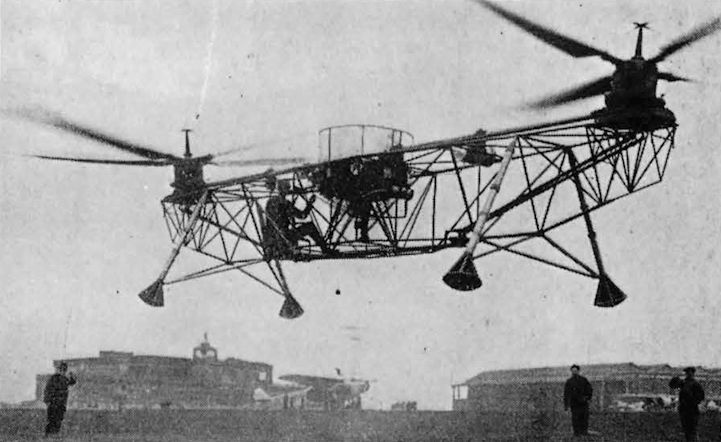
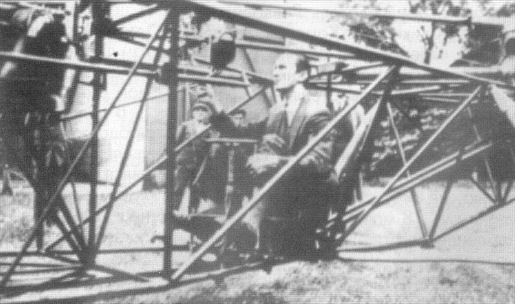
The Florine Type II was begun in October 1931 with a subsidy from the Fonds National de la Recherche Scientifique. This was of similar layout but lighter and of metal construction. Power was from a 200 hp air-cooled Renard engine with an overhead fan. The first flight was on 12.4.33 and testing continued with increasing success. On 25.10.33 it flew for 9 min 58 sec, unofficially beating the world record held by the d'Ascanio helicopter of 8 min 45 sec over a distance of 1078 m and height of 18 m flown by the Italian Marinello Nelli. Modifications and testing of the Florine Type II continued to Spring 1934 until it was decided to hold a demonstration at Brussels-Evere for VIPs and Press to include an official attempt on the record. Unfortunately, on take-off the pilot's foot slipped off one of the two rotor-clutches, making one rotor turn faster, and the helicopter overturned and was badly damaged. This event actually took place on 2.5.34.
There followed a Type III (officially 3BS) which was the first to be officially registered - as OO-STA on 10.1.36. Similar again to the Type II but further lightened, it used two 60 hp Salmson engines. Backers' interest in it diminished when its performance was compared with the Focke-Achgelis 61 and so it was wfu. It was reported to have been dismantled and stored just before the War, with the documentation either going to England, France or the STAe archives.
Post-war Nicolas Florine designed and developed the Type IV which was a four rotor design with an enclosed cabin but construction was halted in 1948/9 due to lack of funds.
- Air-Britain Archive 1-1999
Фотографии
-
Air-Britain Archive 1999-01 / Extracts
The Florine Type II helicopter being flown at Brussels/Evere Airport prior to its crash during a record attempt on 02.05.34.
-

Flight 1933-11 / Flight
Вертолет Н.Флорина в рекордном полете
BREAKING THE RECORD: The Florine helicopter has succeeded in remaining aloft for 9 min. 58 sec. The small propeller above the engine is fitted chiefly to keep the engine cool when the machine is hovering. -

Flight 1933-11 / Flight
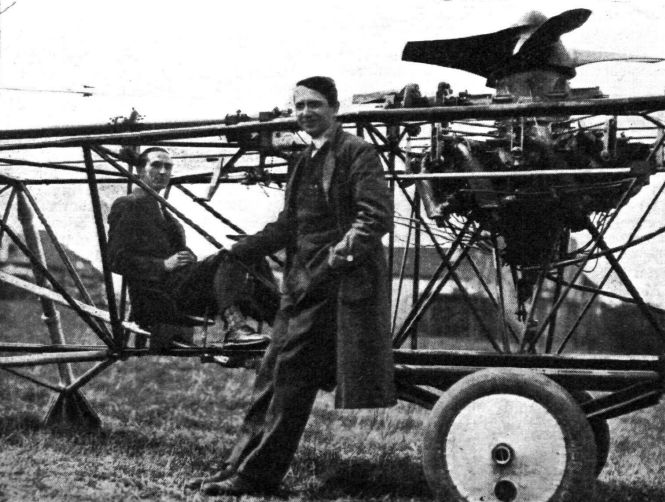
HELICOPTER RESEARCH: N. Florine, the designer of the helicopter illustrated last week, is seen seated in the machine, while standing in front of it is. M. Collin, the pilot, who kept the machine in the air for just under 10 min.
-

Flight 1939-07 / Flight
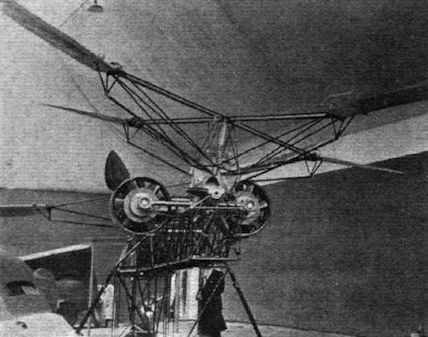
REVOLUTION AND POSSIBLE EVOLUTION: One “sideshow” at the Brussels Show. A (slightly !) developed version of the Florinne helicopter, which at one time held the world’s record for such craft.
-

Авиация и Космонавтика 2007-12 / Е.Ружицкий - История вертолетных рекордов (2)
Инженер-пилот Р.Коллин управляет вертолетом Н.Флорина

- Фотографии