Фотографии
-
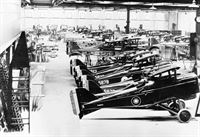
Регистрационный номер: E5823, E5878, E5881, E5882, E5900, E5903, E5905, F8014 A glimpse of Austin’s S.E.5a production line in late 1918/1919. Most of the aircraft are from the batch E5637-E5936, but the foremost machine, F8014, is from a later batch and bears United States Air Service insignia, as does the wing panel in the middle distance. The low overwing Foster mounting on F8014 indicates that it had a direct-drive engine.
Самолёты на фотографии: RAF S.E.5 - Великобритания - 1916
-
Регистрационный номер: SCD14, S1577 Philip Jarrett has sent in the adjoining photograph of what appears to be a Nimrod being fished out of the sea. This was not an unusual event but the markings are out of the ordinary.
The serial on both the fuselage and rudder is 'SCD14'. It does not take too much in the way of deductive powers to translate the CD into catapult dummy. These were airframes that had been taken out of service and were used to test catapults. Fairey IIIFs were a favourite for this role but other surplus types were also used. As the size of aircraft grew, heavier catapult dummies were required and damaged contemporary service types were relegated to this role.
The 'S' is not as easily explained. The fact that the 'S' on the rudder is neatly outlined in white may provide a possible clue. It could be the original letter of the serial to which 'CD13' has been appended, the whole being repeated when it was painted on the fuselage.
The CD numbers ran at least to 30 and it would be nice to have a listing of those which were known. Did they continue throughout the war or even post-war when old Fireflies and Firebrands were used? Doubtless the pilots of the latter type considered this to be the best use for their mounts.Самолёты на фотографии: Hawker Nimrod - Великобритания - 1931
Статьи