

Описание
Страна : США
Год : 1980
(проект)
Air International 1980-08
Light fighter project
WE HAVE read the February 1980 article in AIR INTERNATIONAL on the Piranha and the work being done by the Aerospace Task Force. We believe firmly in the philosophy of the light fighter and have been working extensively on this concept.
Our Chameleon, in the development process at this time, is such a fighter. I enclose some information on this project that I hope will be of interest to your readers.
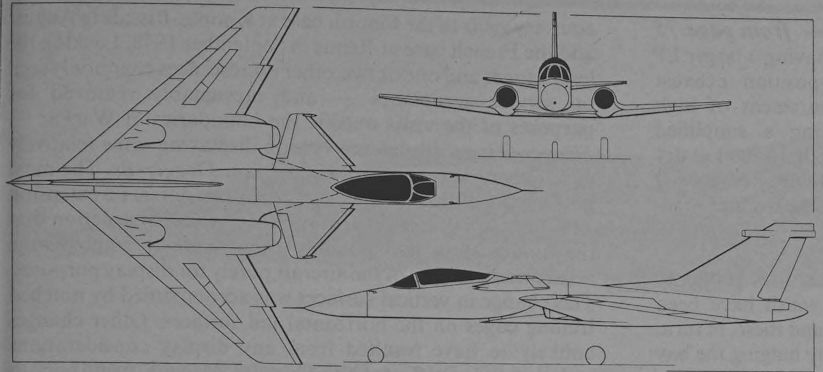
Mock-up and structural design changes are taking place almost monthly. As can be seen, the canard placement is above and ahead of the wing, the canard’s downwash being used effectively by the main wing in reducing the latter’s angle of attack.
Testing has shown excellent root lift distribution by placing the wing leading edge chine extension below the fuselage with a laminar flow splitter, thereby achieving measurable even flow at high angles of attack. Air is channelled over the root sections by the engine nacelles, which are separated to minimise contagious engine failure.
Through Coanda effect, a large percentage of the horizontal thrust is recovered with 60 deg of flap. Sustained 9 g turn rates can be maintained. The mid-span trailing edge segments make up flaperons which are close to the centre of gravity, thereby reducing trim loads. The inboard segments utilise exhaust flow from the engines to augment the lift coefficient.
Spoilers for roll control incorporate follow-on ailerons and these make up the outboard segments of the wing trailing edge. Studies are in progress to utilise single exhaust deflectors on each nacelle for airbrake and thrust reversers. Engine armour is supplied by lower wing skins and steel bearer spars. One hard point is located on the fuselage centreline and two under each wing.
The engines will have low infra-red qualities because of their location and minimum exhaust signatures through exhaust diffusion. To augment the exhaust diffusion process, retractable flow vanes are employed.
To simplify construction of the fuselage sections, the skins are of flat and flat wrap sections with no compound curves. The cockpit section ahead at the break-away line is of steel tubing, with armour plate in bathtub configuration. The Chameleon has the following characteristics:
Power Plant: Two General Electric J85-GE-21 turbojets each rated at 5,000 Ib st (2 268 kgp) or Garrett AiResearch TFE731 series of 6,800 Ib st each (3084 kgp). Fuel capacity, 3,600 lb (1 632 kg) internal, 2,400 lb (1 090 kg) external, giving a total of 6,000 Ib (2722 kg).
Performance (estimated): Max speed, Mach 1-43 at 35,000 ft (10 668 m); economical cruise, Mach 0-85 at 35,000 ft (10 668 m); max rate of climb at sea level, 29,000 ft/min (147 m/sec); combat radius, with fuel for 20 min reserve and 5 min combat, 200 mls (322 km) at sea level; max range, full external fuel, 1,200 mls (1 931 km) at sea level.
Weights (estimated): Empty equipped, 8,000 Ib (3 629 kg); military load, 6,000 lb (2722 kg); max take-off, 20,000 lb (9 072 kg).
Dimensions: Span, 33 ft 4 in (10,15 m); length, 48 ft 4 in (14,72 m); canard span, 13 ft 4 in (4,05 m); height, 13 ft 9 in (4,19 m); wing area, 372 sq ft (34,56 m); canard area, 75 sq ft (6,97 m2); undercarriage track, 9 ft 4 in (2,84 m); wheelbase, 20 ft 10 in (6,35 m).
Daniel R Woodhurst, Aero-Products Company, Sonoma, California, USA
- Air International 1980-08
Фотографии
-
Air International 1980-08 / Talkback
A project drawing of the Aero-Products Chameleon light fighter, as described by its originator Dan Woodhurst.
- Фотографии