


 Wiki
Wiki 
Flight, October 1941
RUDDERLESS FOR SAFETY
The Skyfarer Turns on Ailerons and Elevator
GREAT simplicity of control and optimum safety under all conditions of operation are outstanding characteristics of a light private aeroplane of new design which has been recently announced as in production in U.S.A. The basis upon which the design of the new craft was developed and perfected is an aerodynamic principle that affords full control and manoeuvrability of an aeroplane though the rudder is completely absent. This principle has been developed by Otto C. Koppen, professor of aeronautical engineering at the Massachusetts Institute of Technology, and the construction embodying it, designed by Prof. Koppen, has been patented.
The design and construction of this new craft, named the Skyfarer, have been approved by the Civil Aeronautics Board, which pronounced it "characteristically incapable of spinning," and granted an Approved Type Certificate to the manufacturers, the General Aircraft Corporation, of South Lowell, Massachusetts.
The major objective in designing the craft was to make inherently impossible the various flying accidents which are the result, in the great majority of cases, of pilot mistakes and errors of judgment. Simplification of flight control is the obvious remedy for pilot mistakes, but to be safe the aircraft must have other safety provisions built into it. This has been done in the Skyfarer, which is of a design that makes it automatically stable in flight so that it cannot go into a spin but recovers level flight from the stalled position. It is fitted with a nosewheel undercarriage and with wing flaps. Four years of development work preceded production of the final model.
Landing Speed Range
The results accomplished, according to Charles W. Sutherland, a veteran pilot and president of the company, are that the aeroplane cannot spin, side-slip or skid, nor is control lost in the stalled attitude. It can be taken off or landed in a cross-wind without undue skill, and there is no risk of ground-looping or nosing over. The landing run can be held to less than 200ft., and the craft is completely controllable and steerable after 100ft. of run. Its landing speed can be anything between 45 and 80 m.p.h.
"We are prepared to demonstrate," stated Mr. Sutherland, "that any normal person who can operate an automobile can not only solo the Skyfarer but can also make perfectly banked turns after two hours of dual instruction. After ten hours' flying he will be able to accomplish precision spot landings and will require only further experience in judgment of distance, weather and air speed to be a finished pilot."
Controls
Flight control of the craft is as simple as bicycle riding or car driving, and can be learned as quickly, for with the rudder and its controls eliminated, the student pilot need not acquire that most difficult accomplishment - the co-ordination of simultaneous hand and foot action to adjust ailerons and rudder to the precise relative positions for making turns without skidding toward the outside of the turn or slipping inwards.
Instead of three movable flight controls that must be co-ordinated by hand and feet, the pilot has only two - elevator and ailerons - both operated by the hand wheel. This is, as customary, pushed forward to descend and pulled back to climb, and is turned to control direction in the horizontal plane as in a motor car. Thus all actions are instinctive and nothing has to be unlearned. For instance, there can be no "crossing" of controls, as sometimes may occur in a conventional three-control aeroplane when a pilot makes a banked turn near the ground just after take-off. Appearances due to drift caused by a crosswind may confuse him into thinking he is slipping inwards and so cause him to apply bottom rudder to overcome the imaginary slip. This may produce a dangerous skid towards the upper wing.
Another dangerous mistake that cannot be made with the two-control craft is that of applying rudder on the high side in an attempt to maintain altitude in a bank that is too steep for the power and speed of the aeroplane. This application is made at a time when the plane is losing speed and may easily start a spin in a direction around the high wing.
Assurance against such natural errors of judgment gives the pilot the confidence that is so essential to rapid learning and enables him to make turns with greater precision and at lower altitudes than would be safe with a three-control machine.
Landing Gear
Tricycle landing gears which have been developed in the last five years and are now being applied to some of the largest bombers and transports, are a return to a type used on the earliest flying machines. Besides the obvious advantage of preventing nosing over and ground-looping in event of bad landings, bouncing and skipping do not occur after ground contact because the pair of rear wheels are aft of the centre of gravity. Consequently the tendency is for the tail to rise, decreasing the angle of incidence of the wing, thereby reducing the lift and keeping the wheels on the ground. Application of the wheel brakes immediately after ground contact, or even before, produces no serious results. The nose wheel is steered by the pilot's hand wheel and, therefore, only one pedal is required for the brakes on the main wheels.
Landings with the Skyfarer are made with more precision and with enhanced safety by the use of flaps which can be adjusted by a hand lever to either of two operating positions. Part-down position is used for making a normal landing approach. In full-down position the flaps reduce the stalling speed from 50 m.p.h. to 44 m.p.h., and give the flattest glide path at the lowest speed at which flight can be maintained. The flaps can be applied suddenly if the glide angle seems too flat, or may be raised as easily and safely to reduce the angle and avoid under-shooting the landing spot. The glide path can be controlled, also, by the instinctive actions of raising the nose to prolong the glide and depressing it for a quicker descent so as not to overshoot.
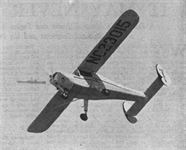
As the photograph shows, the Skyfarer is a high-wing monoplane having a double-fin tail. The fuselage is built up of aluminium-alloy angles and channels assembled with cadmium-plated nickel-steel bolts instead of welding. The cabin seats two persons side by side and affords excellent visibility over the low, flat nose and to both sides. An aluminium-alloy D-section, stressed-skin spar and ribs of the same material, riveted together, compose the wing, which is fabric covered to the rear of the spar. Fabric also covers the fuselage, ailerons and tail surfaces. Power is furnished by a Lycoming four-cylinder 75 h.p. geared engine with rubber mountings.
To simplify inspection and repairs, easy accessibility is afforded to all portions of the aeroplane that should be examined frequently, and use of heat-treated parts and welded structures is avoided as much as possible.
Principal specification figures of the craft are as follows :-
Length, 22ft.; wing span, 31ft. 5in.; height to top of fin, 8ft. 8in.; wheel track, 5ft. 4in. Total loaded weight, 1,350 lb.; empty weight, 890 lb.; disposable load, 460 lb.; tankage, 20 U.S. gal.; baggage 40 lb. Wing loading, 11.1 Ib./sq. ft.; power loading, 18.0 lb. per h.p.; rate of climb, 550ft. per min.; top speed, 100 m.p.h.; stalling speed (flaps up), 50 m.p.h.; stalling speed (flaps down), 44 m.p.h.; landing speed, 45 to 80 m.p.h.
- Flight, October 1941
RUDDERLESS FOR SAFETY
Фотографии
-
Flight 1941-10 / Flight
Регистрационный номер: NC23015 The Skyfarer is an American design intended for private owners. It has only two controls, the necessity for a rudder having been eliminated. Safety should be its long suit.
- Фотографии