

Описание
Страна : Россия
Год : 1938
Единственный экземпляр
Russian Aviation Museum
According to the proposal of Marshall Tukhachevsky the Revolutionary Military Board established on 21 September 1933 a brand new institution - RNII The activities of the new institute began on October 31 by merging of GDL and GIRD. In the beginning the
works on a rocket-glider were not a part of RNII activities and also the development of rocket engines using a liquid propellant was also not in the focus of activities - the main activities were focused on military rockets, using solid fuel.
S.P.Korolev, who was in the beginning the deputy of the chief of the institute and later the designer. Despite the failure of his (joint with B.I.Cheranovskij) RP-1, he still was interested in rocket gliders. Moreover, Korolev, was forced to work in the
area of rocket planes essentially in his free time .
He understood well, that the idea of creation of the rocket plane simply by putting a rocket engine into usual airframe was wrong. He stressed, that there are differences in flight characteristics, trajectories and weights. The development of necessary
airframes could be possible on condition, that there was a reliable and powerful rocket engine. These conclusions he pointed at the conference about utilizing of rocket-powered aircraft for use in the atmosphere, which was held on 2-3 March 1935 in
Moscow.
Original design was a single-seater. Pressurized cabin was not in consideration, instead the pilot was provided with a space suit. Aircraft (empty) was to be very light: 240kg airframe, 200kg fuel system, 200kg compressed air system (used for life
support and to displace fuel components toward the engine), 50kg for engine. The rocket engine should have thrust of 19.6kN and the take off should be assisted by solid fuel boosters. After steep climb (at angle of 60 ) to altitude 32km, aircraft would
glide at the speed of up to 2500km/h, covering 220km in 18min.
From the modern days perspective, it appears very naive to expect a 240kg airframe to withstand aerodynamic loads of Mach 2+ flights and containing pilot, engine and 1200kg of fuel. But back in 30's there were no experimental and theoretical reasons to
question the success...
In the end of 1935 was the rocket-glider adopted into the RNII official plan. Its technical parameters were put together in January 1936 and adopted by RNII deputy director G.E.Langemak and director I.T.Kleymenov. The design was named #Object 218". Its
chief designer was S.P.Korolev and his deputy was E.S.Schetinkov.
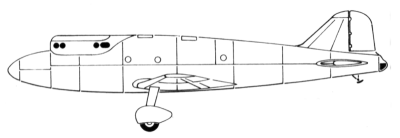
Some changes were introduced in the design. Now it was a two seater, high-altitude experimental aircraft with pressurized cockpit, equipped by a rocket engine (developed by the 1st department of liquid rocket engines, managed by V.P.Glushko). It was
obvious that such a complicated aircraft can not be successfully built without simpler manned technology demonstrator. S.P.Korolev was ready for this: he already built a strengthened glider SK-9, specially intended to fly with a rocket engine. On June 16
1936 the board of RNII decided to proceed with a #supplement" to the Object 218. It would be a experimental aircraft equipped by a low-output rocket engine, named RP-318, essentially a SK-9 fitted with ORM-65 engine and fuel system.
All works were concentrated on this aircraft. The original project 218 was reported in February 1938 for the last time, when S.P.Korolev and Schtetinkov presented perspective applications of rocket-powered aircraft, especially in a role of a fast
fighter-interceptor. They also discussed possibilities of further development of 218 . A rocket aircraft could be built and tested in 4-6 years, weighing about 1600kg, using engine with thrust 4900-9800kN, with possibility to cut off and re-ignite during
flight, thus enabling to prolong the time of operation up to 15-20min. The first version would be launched from a carrier flying at the altitude of 8000m and to be able to reach the altitude about 50km. Following type with more powerful engine and weight
up to 8000kg could reach altitude 80-130km. Designers expected several problems with such a planes, including one with efficient aerial brakes during glide.
The institute was paralyzed already by the wave of arresting and there was not perspective for success. After the arrest of S.P.Korolev in June 1938 the project was cancelled.
Type 218
Function Experimental
Year (presented) 1935 / 1938
Crew 1 / 2
Engine
Thrust 19.6kN / 4900 to 9800kN
Weight
Empty 640 / ?
Loaded 2000 / 1600
Speed
Gliding 2500 / ?
Range
Practical 220 / ?
Flight Endurance 18min / 15 to 20min
Ceiling
Maximum 32 / 50
Payload
Fuel 1200 / ?
- Russian Aviation Museum
Фотографии
-
Russian Aviation Museum /WWW/
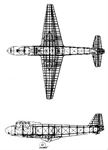
Object 218 in late 2-seater configuration.
-
Russian Aviation Museum /WWW/
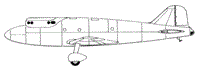
Object 218 in late 2-seater configuration.
- Фотографии