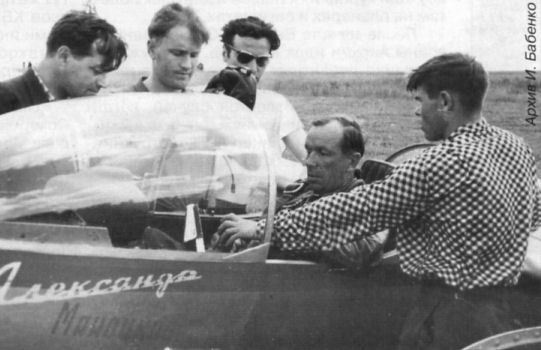
А-13 и А-15 конструкции О. К. Антонова
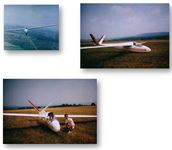
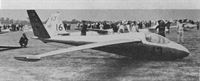
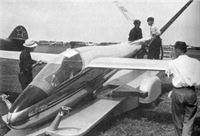
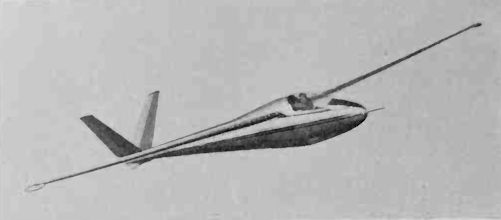
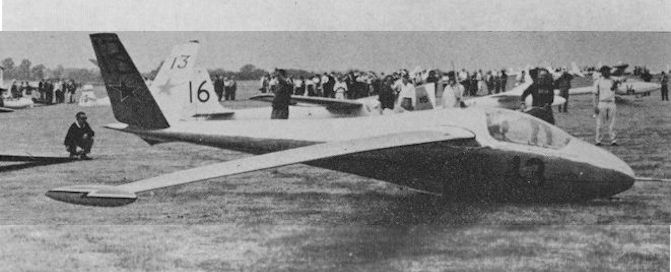
Советский спортивный планер А-13 выполнил первый полет 5 мая 1958 года, а его серийное производство началось в 1959 году. Для ДОСААФ было построено примерно 200 экземпляров. А-13 - небольшой одноместный планер цельнометаллической конструкции с полотняной обшивкой рулевых поверхностей и части фюзеляжа. А-13 спроектирован на основе планера А-11. Он представляет собой моноплан со среднерасположенным крылом большого удлинения, снабженным закрылками, интерцепторами и элеронами. Хвостовое оперение V-образное, без стабилизатора. Шасси состоит из основной одноколесной опоры, хвостового костыля и посадочной лыжи в носовой части фюзеляжа. В феврале 1962 года на А-13 установили небольшой турбореактивный двигатель в гондоле над фюзеляжем. Планер, оснащенный ТРД, получил обозначение Ан-13. На Ан-13 был установлен мировой рекорд скорости - 196 км/ч для самолетов массой не более 500 кг.
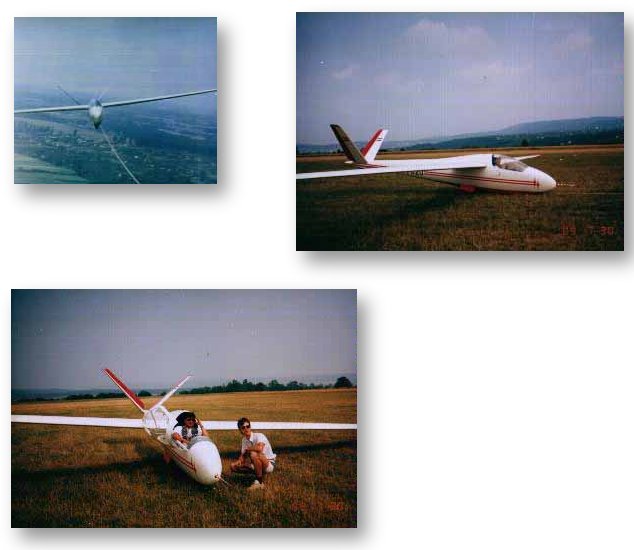
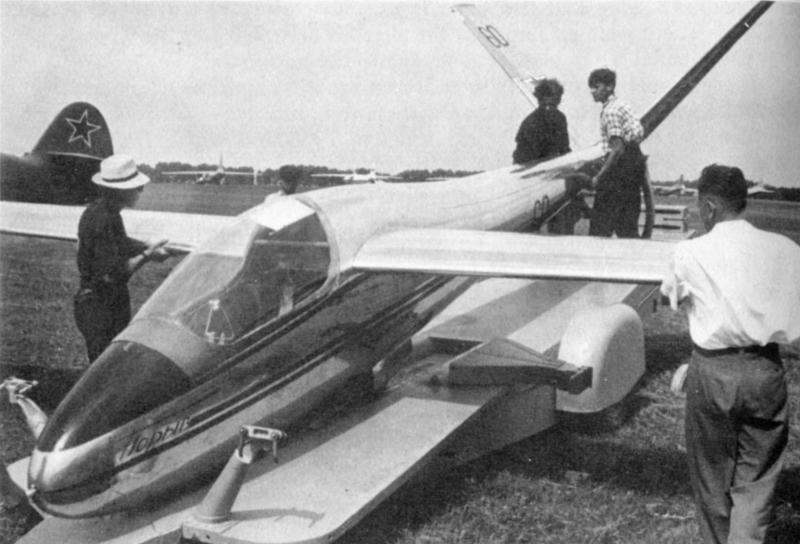
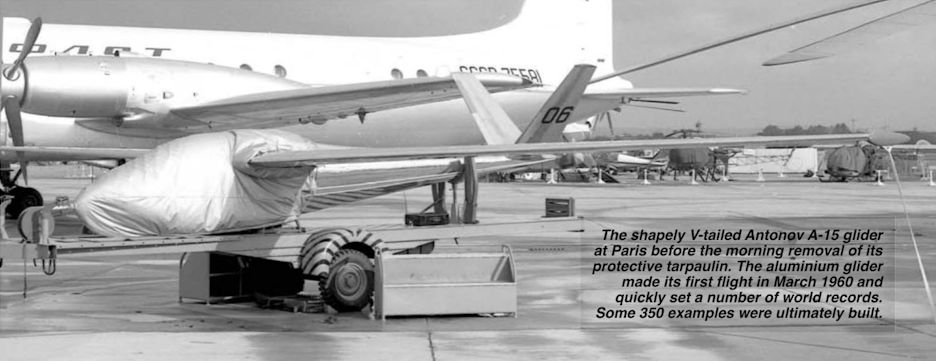
Дальнейшим развитием А-13 стал планер А-15 также цельнометаллической конструкции. Он выполнил первый полет 26 марта 1960 года. Подобно А-13, планер А-15 предназначался для выполнения пилотажа и мог ограниченно использоваться для тренировочных полетов по приборам. Было построено довольно большое количество таких планеров. Одноместный А-15 обладал следующими летно-техническими характеристиками: размах крыла 18,00 м, длина 7,20 м, высота 1,20 м, площадь крыла 12,30 м2, масса пустого 320 кг, нормальная взлетная масса 420 кг, максимальная скорость 250 км/ч.
Варианты
А-13: одноместный спортивный планер
А-13М: мотопланер с поршневым двигателем небольшой мощности
Ан-13: самолет с ТРД тягой 0,55 кН
А-15: дальнейшее развитие планера А-13
ТАКТИКО-ТЕХНИЧЕСКИЕ ХАРАКТЕРИСТИКИ
А-13
Тип: одноместный спортивный планер
Силовая установка: нет
Характеристики: макс, скорость 400 км/ч, аэродинамическое качество 25; скорость снижения 1,1 м/с
Массы: пустого 270 кг; максимальная взлетная 360 кг
Размеры: размах крыла 12,10 м; длина 6,40 м; высота 1,60 м; площадь крыла 10,40 м2
Вооружение: нет
Показать полностьюShow all
M.Hardy. Gliders & Sailplanes of the world
Antonov A-11
Oleg K. Antonov first became known as a glider and sailplane designer in 1930, and his best known prewar design was the high-performance single-seater known as the Red Front 7, which was used by O. Klepikova to set up a women's distance record on 6 July 1939 with a flight of 465.25 miles from Moscow to Otradnoie, near Stalingrad; this record stood for no less than 38 years. Other Antonov designs were the A-1 single-seat elementary training glider, the A-2, a modernised version of the US-5 two-seat training glider, and the A-9 and A-10 single and two-seat high-performance sailplanes. The A-11, which first flew in prototype form on 12 May 1958, is a high-performance single-seater which followed the practice of US manufacturers such as Bryan and Schweizer in being of all-metal construction. The well-streamlined forward fuselage housing the pilot under a blown plastic canopy tapers to a slim boom carrying the cantilever butterfly tail, with an included angle of 90' between the tail surfaces. The A-11 is aerobatic and suitable for both spinning and cloud flying, and the mid-set wing has a single spar in the root and two spars in the outer wings. The leading edge is metal-covered, with fabric covering aft of the main spar. The fabric-covered slotted ailerons can be drooped through 8' to supplement the slotted flaps, and there are also lift spoilers on the wing upper surfaces. The monocoque fuselage has a retractable sprung monowheel and a rubber-mounted tailskid.
Data: A- 11
Span: 54 ft 1 1/2 in
Length: 19 ft 8 1/2 in
Wing area: 130.8 sqft
Aspect ratio: 22.4
Empty weight: 648 lb
Max take-off weight: 882 lb
Max speed: 217 mph (in smooth air)
Max aero-tow speed: 124 mph
Min sinking speed: 2.43 ft/sec at 53.5 mph
Best glide ratio: 32:1 at 60 mph
Antonov A-13
Developed in parallel with the Antonov A-11, and making its first flight exactly a week before the latter the A-13 utilises the same fuselage, undercarriage and tail unit as the A-11 married to a shorter span (39ft 8 1/2 in) wing of lower aspect ratio for aerobatic training. This wing is very similar in construction to the A-11's, with a single spar in the root and two spars in the outer wings, and fabric covering aft of the main spar, but flaps are not fitted and the fabric-covered ailerons are not slotted. There are lift spoilers in the upper surfaces. The shorter span wing results in a higher wing loading of 7.07 lb/sq ft and a much higher minimum sinking speed of 3.74 ft/sec. Altogether about 350 examples of the A-11 and A-13 were built.
Data: A-13
Span: 39 ft 8 1/2 in
Length: 19 ft 8 1/2 in
Wing area: 112.4 sqft
Aspect ratio: 13.8
Empty weight: 560 lb
Max take-off weight: 794 lb
Max speed: 217 mph (in smooth air)
Max aero-tow speed: 124 mph
Min sinking speed: 3.74 ft/sec at 60mph
Best glide ratio: 25:1 at 70 mph
Antonov A-15
The single-seater A-15 is a high-performance Open Class design of all-metal construction like the A-11 and A-13 but considerably more refined than these earlier types, and capable of aerobatics, spinning and cloud flying. The prototype first flew on 26 March 1960 and the A-15 soon set up a number of records, including the World goal flight distance record of 443 miles in June 1960. The mid-set wing has a single aluminium main spar of box section, and there is a 50 litre (13.2 gal) water ballast tank built into the wing; wing covering is all-metal. The light alloy ailerons and Fowler flaps have plastic foam filling between the ribs, and there are lift spoilers on the wing upper surfaces. Small end-plate fairings called 'salmons' can be fitted on the wing tips. The fuselage is a light alloy semi-monocoque structure and the sideways-opening blown plastic canopy opens to starboard. The pilot's back-rest and rudder pedals are adjustable, and there is provision for oxygen and radio. Landing gear consists of a retractable sprung monowheel with brake. The cantilever butterfly tail has an included angle of 90° between the tail surfaces; the tailplanes are of light alloy and the elevators of mixed alloy and wood construction with fabric covering.
Data: A-15
Span: 55 ft 9in
Length: 23 ft 8 in
Wing area: 132 sqft
Aspect ratio: 24
Empty weight: 661 Ib
Max take-off weight: 838 lb
Max speed: 155 mph (in smooth air)
Max aero-tow speed: 87 mph
Min sinking speed: 2.07 ft/sec at 56 mph
Best glide ratio: 40:1 at 62 mph
Показать полностьюShow all
Russian Aviation Museum
The USSR was represented at International Gliding Contests for several years by the A-15 and KAI sailplanes.
The prototype A-15 was first flown on 26 March 1960. In 1965 it was presented on the Paris Airshow. It is a single-seat high-performance sailplane, capable of aerobatics, spinning and blind flying.
The A-15 is a mid-wing cantilever monoplane, with butterfly tail. Construction and covering - all metal, including the flying surfaces. The oval-section monocoque fuselage marked a departure from traditional Antonov tadpole outline, with a smooth tapered
outline aft of the pilot's seat.
The cockpit is provided with adjustable pedals and backseat, sun blind and controllable air intake. Equipment includes artificial horizon, barograph, storage battery, oxygen and water ballast systems, and radio.
The narrow trapezoidal monospar wing has a laminar-flow aerofoil (NACA 643-618 at root, NACA 633-616 at wingtips). The wing, which has 1 30' dihedral, is fitted with slotted Fowler flaps, drooped ailerons and spoilers. Plastics are used for the aileron
ribs and wingtip fairings.
The butterfly tail (45 to the horizontal) has a similar control system to that of the A-11 and A-13.
There is shock absorbing monowheel undercarriage with retractable braking wheel and tail bumper. The A-15 can be easily assembled and disassembled.
Type A-15
Function High Performance Sailplane
Year 1960
Crew 1
Engine none
Length 7.2m
Wingspan 18.0m
Wing area 12.3m2
Aspect Ratio 26.4
Empty weight 320kg
Loaded weight 400kg
Wing Load (kg/m2) 37.3
Sinking Speed 0.63m/sec
Maximum Towing Speed 140km/h
Показать полностьюShow all


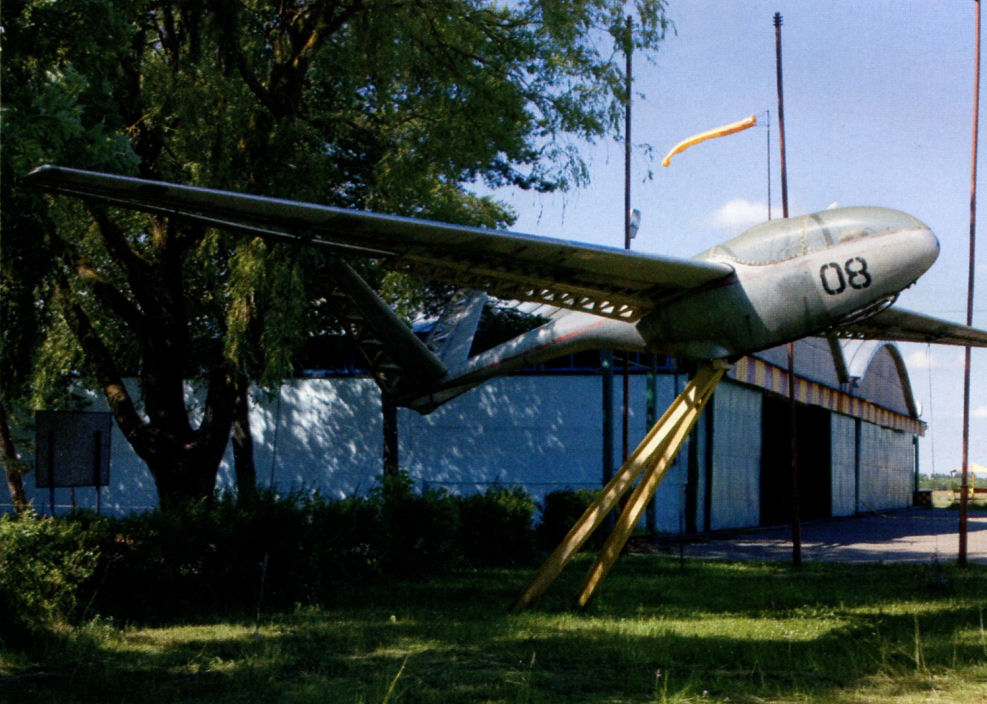
 Wiki
Wiki