Фотографии
-
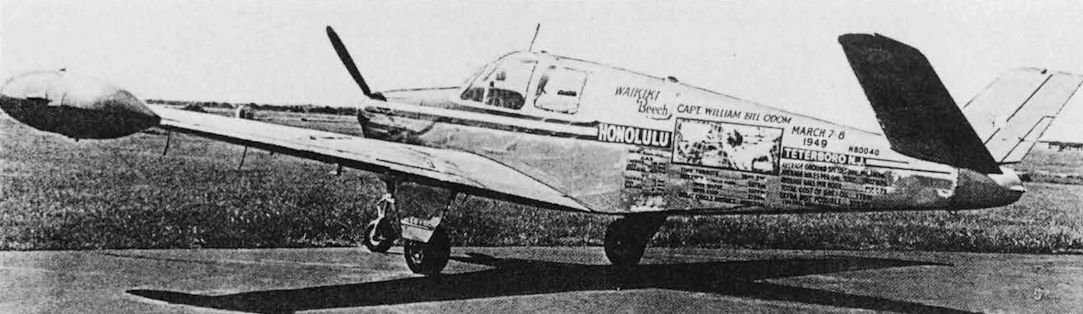
Регистрационный номер: N80040, NX80040 As a high-performance cabin lightplane, the Bonanza was suitable for postwar record breaking, and prototype c/n 4 N80040 was fitted with wingtip tanks for that purpose by Bill Odom and named "Waikiki Beech". After its record breaking career this aircraft was restored for display at the National Air & Space Museum in Washington, DC.
29.11.46 p.647: The Bonanza saga continues! We now know that the crash occured on Wolf Farm near Andover, Kansas, a few miles from Wichita on 26.10.46. Test pilot Harry L. Reiter was killed but observer Robert King parachuted to safety. We have not positively identified the prototype that was destroyed but we can clarify the position more: Larry Ball's book "Those Incomparable Bonanzas" helps a little. There were 5 pre-production prototypes, 2 used for static test, 3 used for service tests. The first to fly, on 22.12.45, had a laminar flow wing and Lycoming GO-290 of 165 hp. It was tested for about 50 hrs. This appears to be c/n 3. The 2nd to fly had the NACA 2300 wing and 165 hp Continental engine. This seems to be c/n 4. Performance of the two was nearly identical. C/n 5 was definitely a fatigue test airframe.Самолёты на фотографии: Beechcraft Model 33/35 Bonanza - США - 1945
-
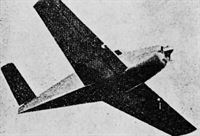
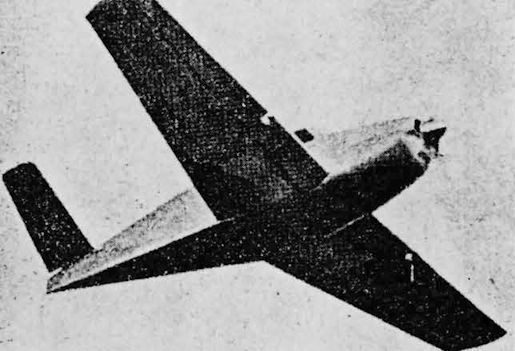
Регистрационный номер: NX80150 Another Bonanza prototype, NX80150 c/n 3, which does not have the advanced leading edge root fitted to NX80040 and standardised on production. It is not known if this was the laminar flow wing prototype but certainly NX80040 had the NACA 2300 aerofoil used on the production aircraft.
Самолёты на фотографии: Beechcraft Model 33/35 Bonanza - США - 1945
-
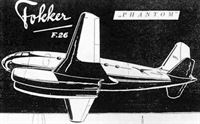
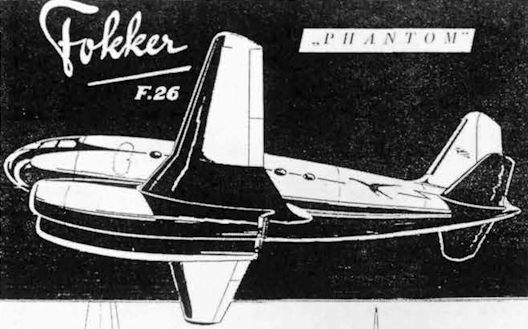
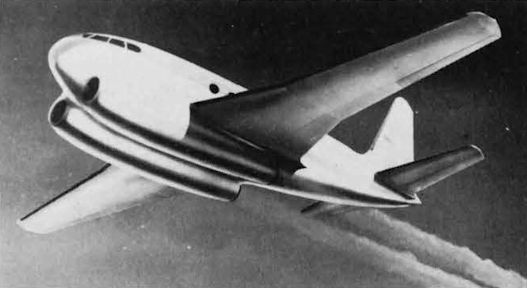
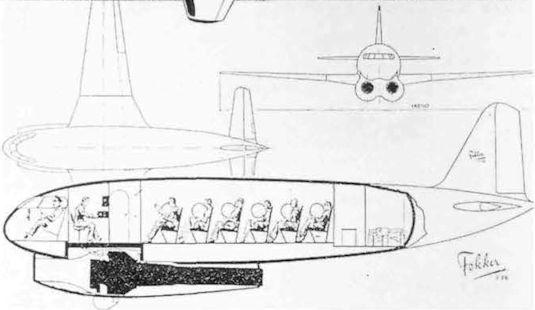
2.5.47 p.464: The Fokker F.26 Phantom was considered as a study project and was never built. Fokker and KLM wanted to investigate the economic feasibility and the technical problems of a jet airliner. It was an all-metal, low-wing 17 passenger transport with a pressurised cabin. Proposed power units were RR Nenes, the most powerful available at the time, located under the forward fuselage for ease of maintenance. Underwing flaps were intended but no details of the tricycle undercarriage were revealed, indeed it would have required very long legs because of the engine location. Crew was three, 2 pilots and a rear-facing radio operator. Passenger seating was in 6 rows of two on the right side and one on the left, with one seat for a steward/ess. The aft cabin contained a toilet and freight compartment. Length was 50'6", wingspan 59'9", loaded weight 25,360 lb and range 620 mis at 500 mph.
Despite the large number of war-surplus transports available there were positive airline reactions to the jet airliner concept and Fokker produced further design proposals. High development costs led to discussions with other manufacturers, including De Havilland, but by 10.49 the Netherlands Institute for Aircraft Development announced a jet/turboprop comparitive study which in due course resulted in the F.27 Friendship.Самолёты на фотографии: Fokker F.26 Phantom - Нидерланды - 1946
-
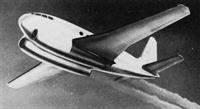
Artist's impression of the F.26 Phantom in flight.
Самолёты на фотографии: Fokker F.26 Phantom - Нидерланды - 1946
-
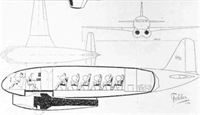
This drawing from a Fokker advertisement of 1946 shows an impression of the F.26 and a three-view. In the cut-away side view the pressure cabin is clearly outlined, with pilot, radio operator, six rows of seats, toilet and luggage compartment.
Самолёты на фотографии: Fokker F.26 Phantom - Нидерланды - 1946
-
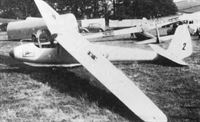
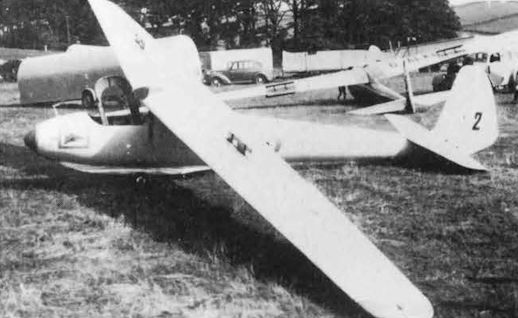
Регистрационный номер: VS201, LF-VO 10.1.47 Glider Survey: The Royal Navy sailplanes were Kranichs VS208 & VS213, Meise VS201 (see photo), Grunau VS220 and a Mu 13A LG+WZ which eventually became XD371 in 1952.
Ex-German gliders (see 10.1.47 entry) included RN DFS Meise VS201 at Great Hucklow 1951.Самолёты на фотографии: DFS Meise - Германия - 1938
-
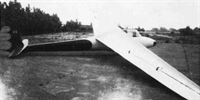
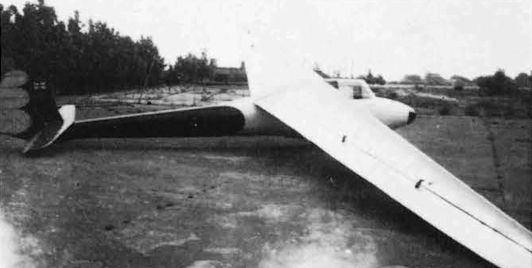
10.1.47 Glider Survey: Peter Green adds that Flt/Lt "Jock" Forbes, OC the BAFO Gliding Club, Oerlinghausen 1948/9, who was at the Home Command Gliding Instructing School at Detling in 1950, had a Weihe marked "GRCF" in black on red (see photo) which may have come from Germany. He flew it in the Nationals at Great Hucklow 6.51, where Peter also noted an unidentified Mu 13.
Ex-German gliders (see 10.1.47 entry) included unidentified Weihe "GRCF" at Detling 6.50.Самолёты на фотографии: DFS Weihe - Германия - 1938