

Фотографии
-
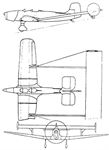
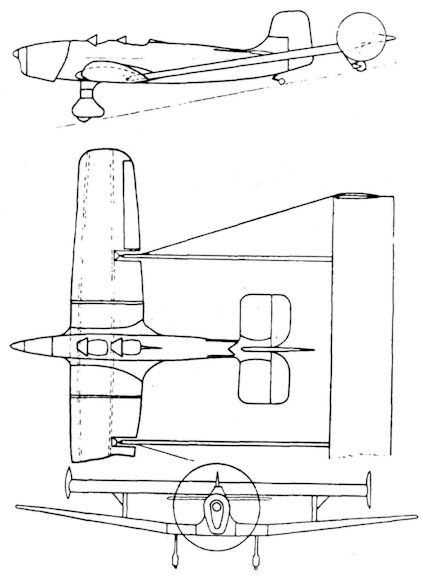
In the summer of 1941, trials were carried out to test the viability of using trailers to increase either the fuel load or the bomb load. It was envisaged that the Halifax II and Blenheim IV would benefit from such trailers as it would give them an increased bomb load for short ranges but it would also improve range/load if it could be fitted with fuel tanks and jettisoned when these were exhausted. On the debit side, the trailer wing lengthened the take-off run and reduced the rate of climb of the aircraft. Bombs would be carried in streamlined nacelles.
With such wings, it was calculated that the Halifax would not benefit greatly but the Blenheim would be able to carry a 4,000-lb bomb load for 300 miles.
The trailer consisted of a rectangular wing, known as the Malinowski wing, with circular endplates which was joined by two booms fixed rigidly to the trailer and pin-jointed to the rear spar of the aircraft. By releasing the pin joints, the trailer could be jettisoned. The undercarriage consisted of a castering wheel under each boom which could be locked before take-off.
A Magister was selected for initial flying experiments to see if the idea was practicable and streamlined lead ballast weights were carried on release points which could be released electrically by the pilot.
On 12 May 1941, L8326 carried out the first flight at Boscombe Down. This was not very successful and an extension was added to the Magister's fin and to the rudder balance horn to improve directional control. It was found that the Magister could be taxied up to 10 mph with the trailer wheels unlocked but during the take-off run the contraption was directionally unstable due to the aft position of the overall centre of gravity relative to the aircraft wheels. It was very difficult to keep the aircraft straight until take-off speed approached, full rudder and brakes being necessary to check the swing. This became progressively more difficult as the trailer weight increased and at 670 lbs it became impossible to stay on the runway. It the trailer wheels were locked, the ground run was stabilised but the pilot had little control over his direction. On a smooth surface, it was possible to steer a straight course but if bouncing took place it was impossible to predict the take-off path.
If the trailer became airborne first, the aircraft could swing before take-off speed attained. One-and-a-half hours flying time at various weights were carried out, including climbs and dives. The stability was satisfactory about all axes and, apart from the rudder, control was adequate after modifications. Landing was normal so long as the trailer touched down after the aircraft.
Four flights were carried out from Boscombe Down in May 1941 and on the 29th L8326 went to Woodley to be modified. On 14 June, it was returned for further tests by the RAE and nine more flights took place. On 24 July, it flew to Woodley and back and then flew to Wrington and back on the 29th. Was this a clerical error for Wroughton? On 30 July it went to Heath Row and on the 31st and 1st August to Woodley.
On 19 August, L8326 swung on take-off and headed off the runway, to collide with an obstruction. At this point the tests ended. The Magister was repaired and re-issued to a more conventional owner.Самолёты на фотографии: Miles Magister / M.14 - Великобритания - 1937
Статьи
- -
- Farnborough Log (1)
- Out of the Archives
- Picture Pages
- Stockport aircraft factories