

Описание
 Wiki
Wiki 
Страна : Россия
Год : 1994
Летающая лодка
Single- or twin-engined light multipurpose flying boat with optional detachable two-wheel landing gear
Варианты
- Чернов - Че-22 Корвет - 1994 - Россия
- Царьков С.Ф. - Фрегат - 1995 - Россия
- Чернов - Че-25 - 1996 - Россия
Russian Aviation Museum
Che-20
In the middle 80's Boris Chernov from Samara (Hope you know this city on the Volga river. In USSR it was called Kujbyshev) He was an experienced water tourist, and in meantime found out that he is tired of pulling his motorboat through the numerous dams
during cruises down the rivers.
Since he has some friends in experimental aviation they started to create a flying boat.
First project was single engine 2-seat tandem, next - 2 seat side-by-side twin engine (Che-20), both powered with outboard 25hp Russian engines. Those aircrafts had the small floats under wings.
Type Che-20
Function Utility amphibian
Year 198*?
Crew 1
Engines 2*30hp 'Vikhr'
Length 6.20m
Wingspan 11.0m
Wing area 14.0m2
Empty weight 260kg
Loaded weight 530kg
Wing Load (kg/m2) 37.9
Power load (kg/hp) 8.83
Cruise Speed 100km/h
Maximum Speed 130km/h
Takeoff Speed 60km/h
Landing Speed 75km/h
Takeoff Roll 70m
Rate at 0m 1m/sec
Fuel 20l
Seats 1+2
Che-22
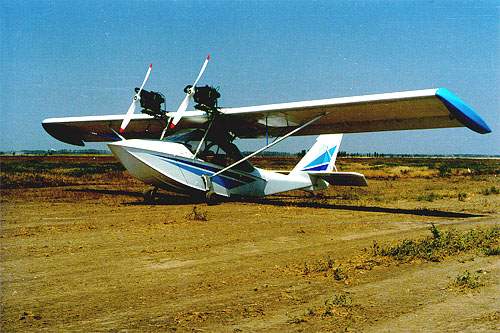
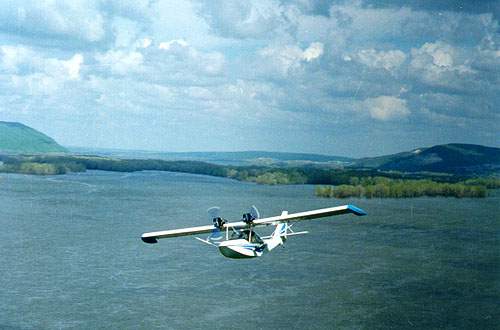
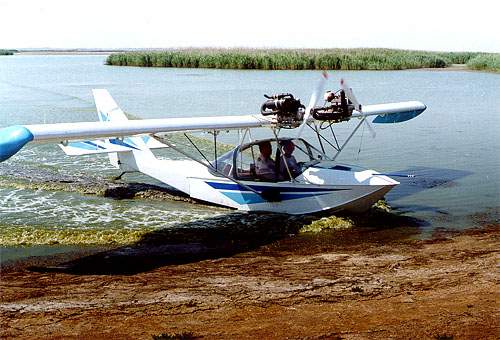
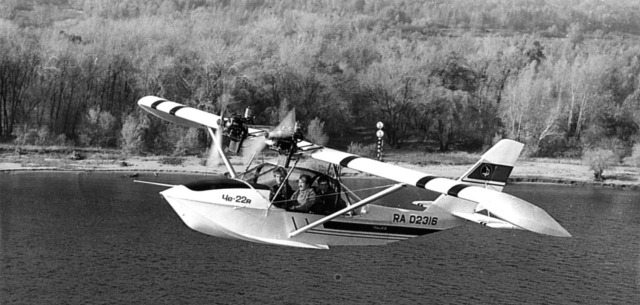
Home-built twin-engine parasol flying boat. Aircraft was developed from earlier Che-20. Small underwing floats were replaced by enlarged anhedral wingtip. This became a standard on all following models. In early 90's designers came to manufacturing
Che-22 for sale. STOL performance allows to operate even from small forest lakes and rivers and perform variety of tasks:
- Ecological monitoring
- Border patrol
- Training
- Tourism
Che-22 is designed and built in compliance with JAR-VLA, FAR-23 and AP-23 flight standards. It become one of the first Russian homebuilts which is manufactured for common use.
During 5 years Che-22 and its predecessor Che-20 logged about 500 hours of trial and training flights. About 120 pilots were trained. Aircraft evolved from 2-seater powered by 30hp boat engine to 4-seater with pair of Rotax (either 503 or 582) engines.
Fuselage is made of epoxy/foam composite sandwich, wings - aluminum with fabric skin. Latest variants have electrically driven gear retraction, mechanical flaps, and an optional BRS 'Cobra' parachute.
Cabin has two removable butterfly-type doors. Basically showed as 2-3 place aircraft (nevertheless may be flown even with 5 men aboard). Windshield may be opened to access the engines while on the water.
Aircraft is available for customers as a 75% pre-assembled kit or as a ready-to-fly aircraft. Two-, three- and four-seat variants with engines (single or two) totaling power from 60hp to 140hp were test-flown and may be delivered. Technical support is
(was?) provided by Povolzhski Aviation Science&Technology Center.
Soon after production of Che-22 started, B.Chernov left the company and started his own design group which made Che-25 and Che-15.
As of beginning of 1999 about 30 Che-22 were built and sold mostly in Russia (also 1 was sold to Philippines and then re-sold to Vietnam, one - to South Africa, one - to Ukraina, one - to Greece). Aircrafts can be produced both as pure flying boat and
amphibian with retractable gear. BRS can be installed.
Type Che-22
Function Light amphibian
Crew 2
Engines 2*64hp Rotax-582
Fuel consumption 18l/hour
Empty weight 370kg
Loaded weight 650kg 750kg
Cruising Speed 150km/h 145km/h
Maximum Speed 170km/h 190km/h
Takeoff Speed 60km/h
Landing Speed 50km/h
Takeoff Roll (Land) 50m
Takeoff Roll (Water) 70m 30m
Gear retraction time 15sec
Seaworthiness 0.5m
Front wind 6m/sec
Side wind 12m/sec
Operational air temperature 20...+40 C
Range (normal) 430km 600km
Range (ferry) 1200km
Climb At 0m with crew only 9.5m/sec
Fuel (main) 80l
Fuel (external) 140l
Seats up to 2?
Cargo 160kg
- Russian Aviation Museum
Фотографии
-
АвиаМастер 2006-05
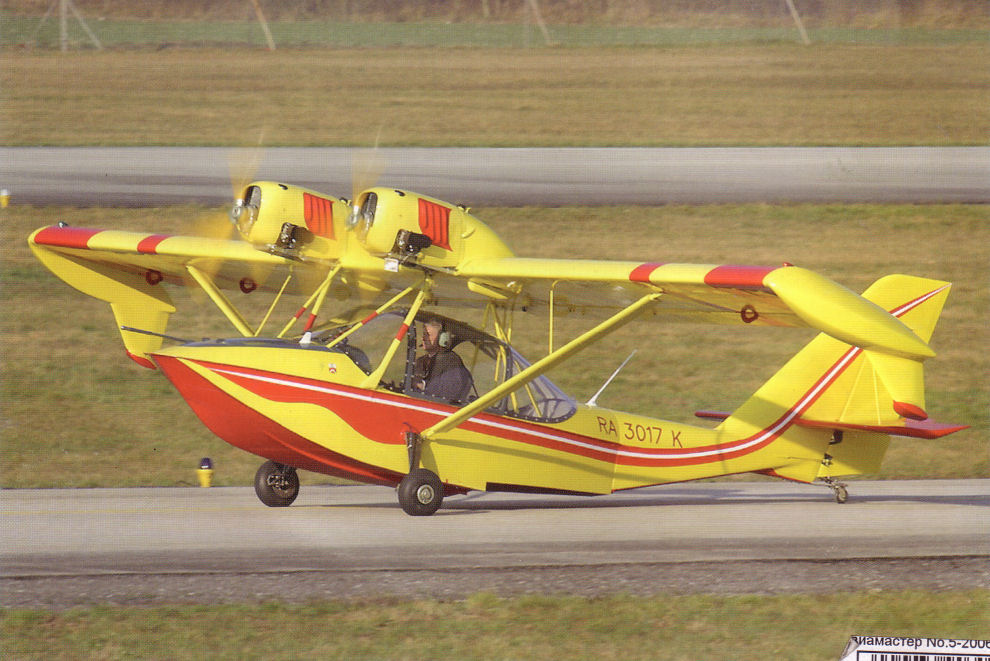
Регистрационный номер: RA-3017K Современный российский гидросамолет-амфибия - легкомоторный "Корвет" производства самарского ООО "Гидроплан"
-
-
-
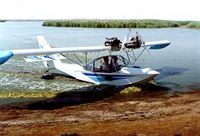
Russian Aviation Museum /WWW/
Один из легких самолетов-амфибий Че-22Р-2
-

Jane's All the World Aircraft 2000 / 2-01 - AIRCRAFT - FIXED-WING - CIVIL
Регистрационный номер: RA-02316 Che-22R-2 flying boat (two Rotax 503 piston engines) (1998)
- Фотографии