 Wiki
Wiki 
Фотографии

-
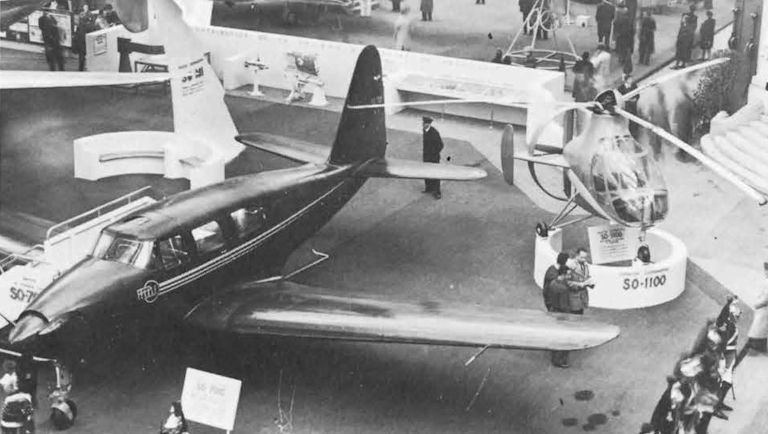
Air-Britain Archive 1992-03 / Extracts. Paris 1946 (2)
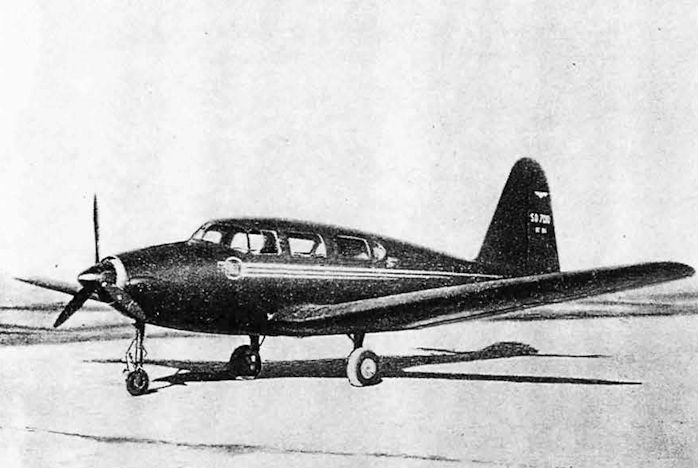
Регистрационный номер: F-WEAG [2] The prototype SO.7010 Pegase on the left had a large cabin for up to 6 passengers and a retractable tricycle undercarriage. Its 400 hp Mathis G16R engine was an 'X' in-line with 4 rows of 4 cylinders and its design was based on the 8-cyl G8R inverted vee in-line with a new crankcase having another vee 8 mounted upright on top. It appears there was no market for the Pegase as no production is known.
On the right is the SO.1100 Ariel which was basically a helicopter with a pusher propeller added. It was a compact egg with a bright orange paint scheme. The three jet-tipped rotor blades were driven by a Turbomeca compressor powered by its 170 hp 7-cyl Mathis G7R radial engine. This also supplied shaft drive for a wooden 3-blade fixed pitch pusher propeller inside an annular ring, replaced by an orthodox tail boom on the SO.1110 and SO.1120.Другие самолёты на фотографии: Sud-Ouest SO.1100 Ariel - Франция - 1947
-
Air-Britain Archive 1993-03 / Extracts. Paris 1946 (6)
Регистрационный номер: F-WEAG [2] The SO.7010 Pegase 6-seater was mistakenly said to have two 200 hp Mathis 8-cyl G8 engines, which gave rise to press reports of side-by-side and tandem installations. In fact the engine was a 400 hp G16R which had two crankshafts side-by-side each driven by a sideways-mounted vee of 8 cylinders, thus forming an X engine lying on its side, 40.7 in. wide by 28.3 in. high. Each crankshaft was de-clutchable from the reduction gear drive so that the aircraft could cruise economically on either half of the engine. The confusion arose because each half was described as equivalent to a G8 engine. This complicated system was not a success for the Pegase and after its first flight 27.2.48 the sole prototype F-WEAG was only test flown. It was reported to be intended for restoration for the Musee de l'Air; what did happen to it?