Фотографии
-
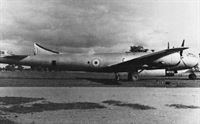
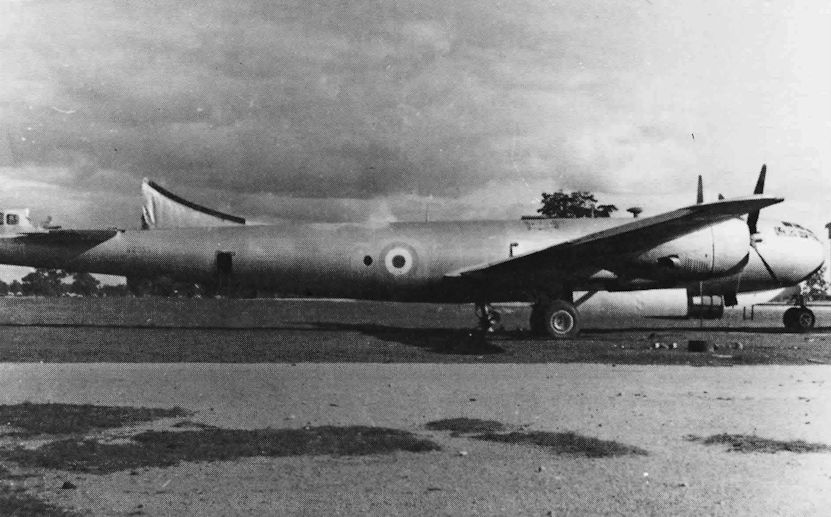
Регистрационный номер: WW583, A76-1 The photograph for this month's Picture Page is of a tail-less Washington at Tocumwal, NSW, on 3 September 1961, taken by John Hopton. It was A76-1 but the former serial WW583 is still carried on the fuselage. Is something hanging out of the bomb bay or is it a drum on the ground? The trees sprouting out of the top of the fuselage are not for camouflage purposes.
Самолёты на фотографии: Boeing B-29 Superfortress - США - 1942
-
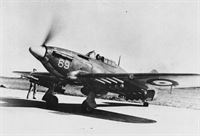
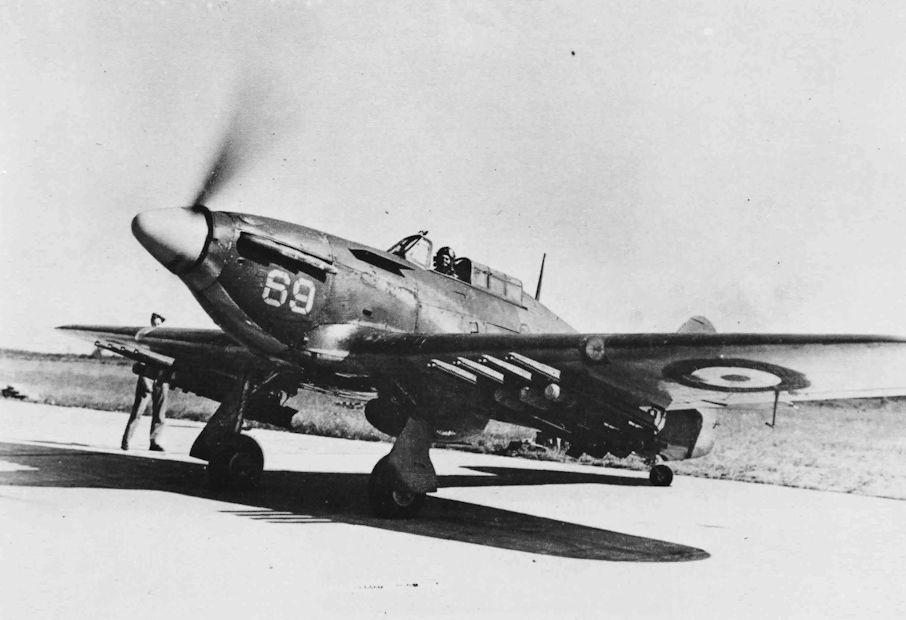
The large photograph depicts a Hurricane IIB fitted with RP racks for eight rockets. The '69' on the nose perhaps gives away the fact that it Is no standard RAF Hurricane but a Canadian-built example, possibly a Mk.XII or a Mk.XIIA, which had only eight guns. The outer gunports cannot be seen on the original. Nothing else is known of the identity, unit or location of the photograph.
The Canadian Hurricane has the standard rocket rails as fitted to the Mk.IV but it does not have the armour-plated radiator that came with ground-attack versions. So it is presumably a trials or training aircraft. On the Mk.XII, the outboard four guns projected slightly from the thinner section of the wing so that would make it a XIIA. The spinner is different from the Rotol version in being a straight-sided cone shape, much simpler to produce than the curved Rotol spinner. The Rotol propellers were only shipped out to Canada for trials purposes, Canadian-built aircraft being fitted with these on arrival in the U.K., RCAF aircraft being normally flown without spinners.Самолёты на фотографии: Hawker Hurricane - Великобритания - 1935
-
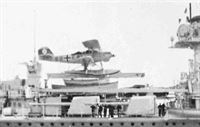
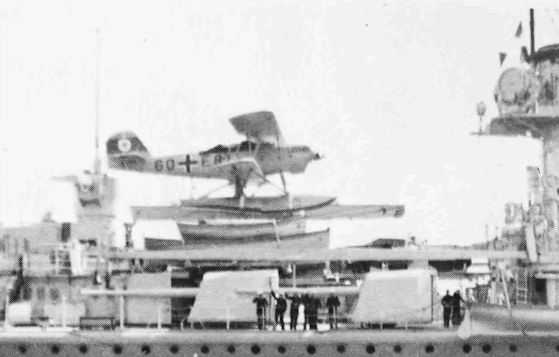
One of the advantages of cruising in the Channel in the late 1930s was the chance of snapping, with a ubiquitous Box Brownie, a Heinkel He 60C on the catapult of a Panzerschiffe. In this case, she seems to be 'Admiral Graf Spee', beloved by the press as a 'Pocket Battleship'. Such was the fervour for this name that even today documentaries on TV refer to 'Tirpitz' as a pocket battleship, all 52,600 tons of her!
Самолёты на фотографии: Heinkel He-60 - Германия - 1931
-
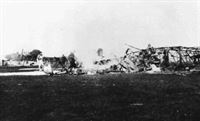
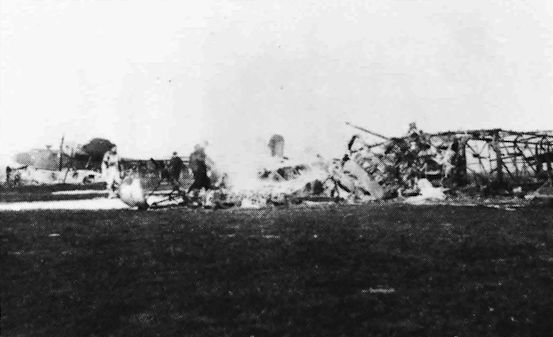
A tailpiece to the item on No.271 Squadron in AM.3/87 is the photograph of the wreckage of the squadron's Harrows at Melsbroek on 1 January 1944.
Самолёты на фотографии: Handley Page Harrow / H.P.54 - Великобритания - 1936
-
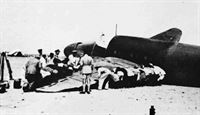
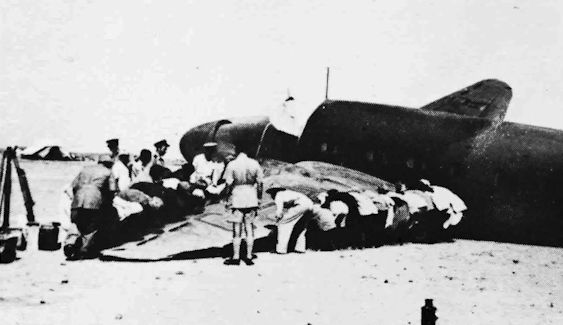
Trying to right a Lodestar in the desert. The letters G and R appear on the camouflaged wing; the other letters?
The crashed Lodestar is, John Davis reckons, G-AGCR which crashed at Malta on 13 May 1942 when the port undercarriage leg collapsed on landing, presumably at Luqa. Or was it on take-off as other readers suggest? Apparently it caught fire but there seems no sign of this and such incidents were usually terminal on Lockheed twins like the Hudson and Lodestar. The undercarriage leg tended to rupture a fuel tank and flood the hot engine with petrol. The evacuation record for these aircraft tended to be of Olympic standards.
Another possibility given by Jack is G-AGBR which survived the war. It is reasonably intact in the photograph so could have had an accident that was less drastic than G-AGCR's.Самолёты на фотографии: Lockheed Lodestar L-18/C-59/R5O - США - 1939
-
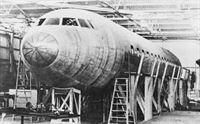
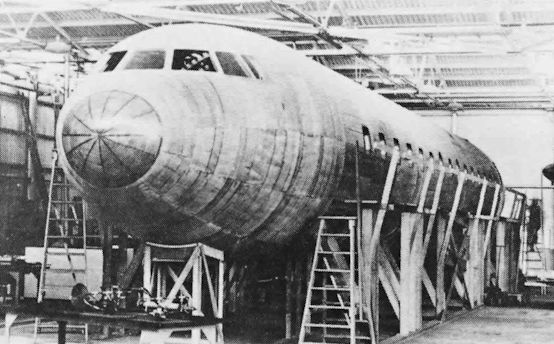
Also from John comes the photo of the mock-up for the Tudor Is intended to be built in Australia by the Government Aircraft Factory at Fisherman's Bend. Twelve were to be produced and the RAAF serial block A76 was allotted. However, the problems with Tudors already built in the UK resulted in the programme not proceeding further than the mock-up.
Самолёты на фотографии: Avro Tudor / Type 688/689 - Великобритания - 1946
-
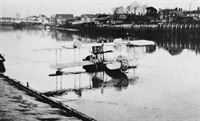
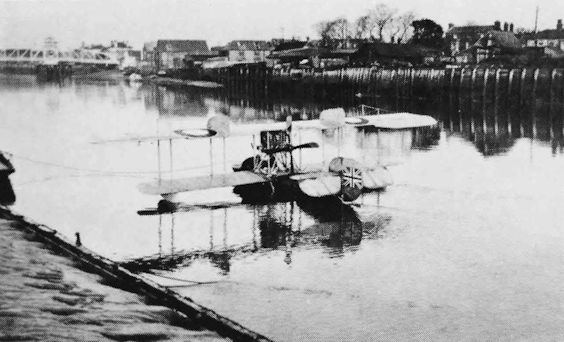
The flying boat is, we are fairly certain, built by Norman-Thompson but it does not seem to be the common NT.2B version as the tail is wrong. The bridge in the background is, presumably, Littlehampton's swing bridge and the Norman-Thompson works were just along the coast at Bognor Regis. The union flag on the rudder suggests an early version of this little flying boat. The main production of two-seat training boats were NT.2Bs used at Lee-on-Solent and Calshot and they were also built by Saunders at Cowes, Isle of Wight, and Supermarine at Woolston.
The flying boat at Littlehampton is not a Norman Thompson but a White & Thompson No.3, probably serial 1195, the first of eight known to have been built and given the serials 1195-1200, 3807 and 3808. There is a close resemblance to the Norman Thompson boats but we did say the tail looked wrong. The White & Thompson company at Middleton-on-Sea, Bognor, changed its name to Norman Thompson later in the war.Самолёты на фотографии: White & Thompson NT.2 - Великобритания - 1915
-
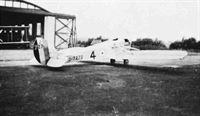
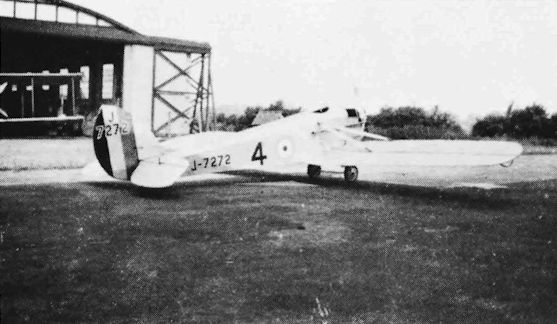
Регистрационный номер: J7272, G-EBTT D.H.53 Humming Bird J-7272; at Northolt ?
Самолёты на фотографии: De Havilland Humming Bird / D.H.53 - Великобритания - 1923
-
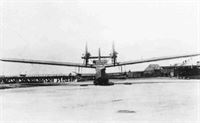
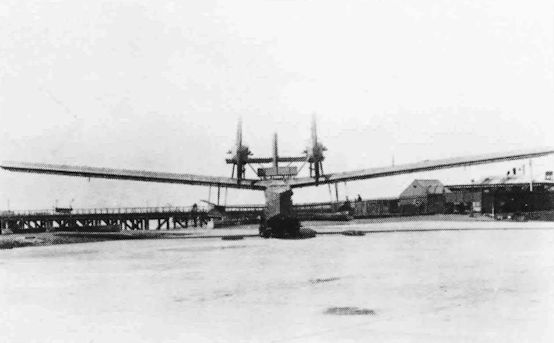
Регистрационный номер: N183 The Beardmore Inverness, seen at Felixstowe, was in fact the Rohrbach Ro IV built in Copenhagen. One of a series of metal flying boats built in Denmark to avoid the Allied Control Commission in Germany, the two Ro IVs in the UK contributed much to the Beardmore Inflexible.
Самолёты на фотографии: Rohrbach Ro.II - Ro.IV - Германия - 1923