

Фотографии

-
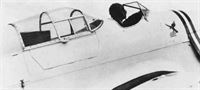
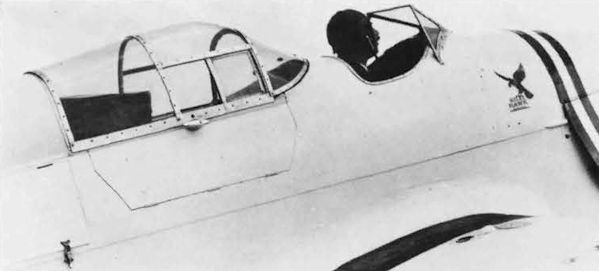
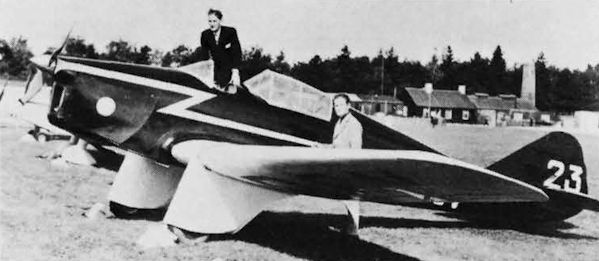
Регистрационный номер: G-ADCV [2] A 1935 photograph showing details of the enclosed hood over the two-seat rear cockpit of Miles M.2M Hawk Major G-ADCV when it was based at Heston.
Flight September 23rd 1948 *Ads - M2M Hawk Major 3-seater, flown from India to England in December 1947 and last flown March 1948, prior to CofA expiry. For sale by Shackletons for £125. In Flight of December 23rd the price was down to £95.
F: 23.9.48 *Ads - M.2M Hawk Major G-ADCV c/n 156 was flown back from Poona by Lt Col G H Wotton, but does anyone have a record of the outward journey? Was it not owned by Ron-Paine from 1944 and how did it avoid impressment? Regd to B.H.St A. Hurle-Hobbs on 18.1.49, it was destroyed by a hangar wall collapse at Croydon 4.2.50.
F: 23.9.48 Ads - The Miles M.2M Hawk Major G-ADCV c/n 156 had been owned by J E D Houlder in 1935. It was put in storage in a garage at Hatfield and when Ron Paine came across it in 1944 he purchased it, obtaining a CofA on 13.3.46. He entered it for the Siddeley Trophy in the first post-war Air Races at Lympne on 31.8 - 1.9.46 and it came second at 129.5 mph. It had two 16 gallon fuel tanks in the wing roots which gave a 4 1/2 hr endurance, enabling him to use it for attending rallies on the Continent. Its long range attracted the attention of a retired RAF pilot Laurence Aelred Harris, who purchased it in 1947 (regd to him 3.4.47) for the flight to India, afterwards advertising it for sale in a Bombay newspaper. It was then purchased by Lt Col Gordon H Hotton, a member of the Karachi Flying Club. He wanted to do the flight in the opposite direction as he was being repatriated. He left on 18.11.47 and arrived home at Hamble after 55 hr 30 min flying time. He used 390 gal of petrol at 7 gal/hr, the norm for a Gipsy Major, and covered a distance of 5510 miles. He registered G-ADCV on 16.1.48 but shortly sold it to Basil S StA H Hurle-Hobbs of Croydon to whom it was regd 18.1.49. It was wrecked when a hangar wall collapsed in a gale and fell on it at Croydon on 4.2.50. Only one other M.2M Hawk Major with the enclosed rear 2-seat cockpit which identified the type was built. This was LN-BAH "Fefor" c/n 128 of C F Walter of Vinstra, Norway, which crashed and burned at Kjeller on 10.12.35.Самолёты на фотографии: Miles Hawk / M.2 - Великобритания - 1932
-
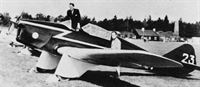
Регистрационный номер: G-ADCV [2] G-ADCV at Lympne in 1946 with owner R.R.(Ron) Paine by the front cockpit. The windscreens and rear cockpit have been redesigned following use with the rear cockpit open, probably due to deterioration of the 1935 cover.
Самолёты на фотографии: Miles Hawk / M.2 - Великобритания - 1932
-
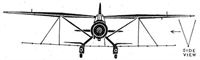
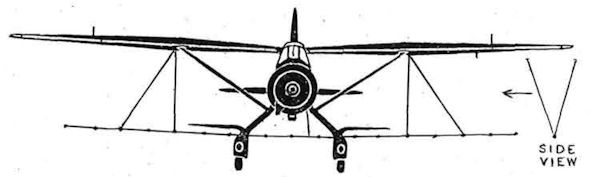
Ex-RCAF Lysanders were fitted with specially designed low-slung spray bars for crop spraying in Canada: see 12.11.48.
Aeroplane November 12th 1948 *p.609 - Westland Spraying Services Ltd of High River, Alberta, is using six Lysanders converted for spraying. A 200 gallon tank is installed in the rear cockpit.
A: 12.11.48 p.609 - The six Lysanders converted for crop spraying by Westland Spraying Service of High River, Alberta, were modified to carry a 200 gal spraying fluid tank in the covered-in rear cockpit. The spray bars gave a swathe width of 175 ft which was considerably greater than that of helicopters and light aircraft such as Cubs used by other operators. The all-up weight was increased by 1400 lb to 7500 lb. Spraying runs were flown 50 ft above the ground at an indicated airspeed of 160 mph. Some aircraft (eg CF-FOA which was demonstrated at the 1948 Calgary Air Show) were without the undercarriage stub wings and had the feed pipe to the spray bars on the right hand side. The spray bars were pressure fed from two wind-driven pumps on the wheel spat gun mountings. The spray bar jets had magnetic valves, operated by pressing the gun firing button on the control column.Самолёты на фотографии: Westland Lysander - Великобритания - 1936
-
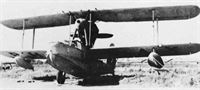
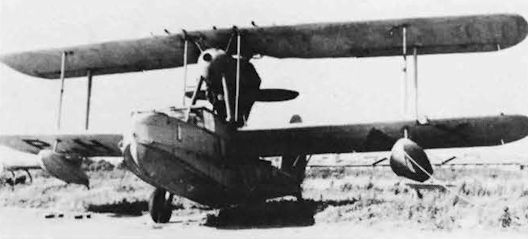
Регистрационный номер: PH-NAX The Walrus I PH-NAX which was offered for sale in Flight of 24.6.48.
Flight June 24th 1948 * Ads - For sale, Walrus I including spare engine, 350 hrs since new, 11 hrs since overhaul offers? Lutec, Singal, Amsterdam.Самолёты на фотографии: Supermarine Walrus/Seagull V - Великобритания - 1933
-
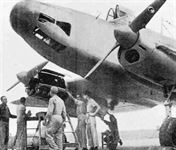
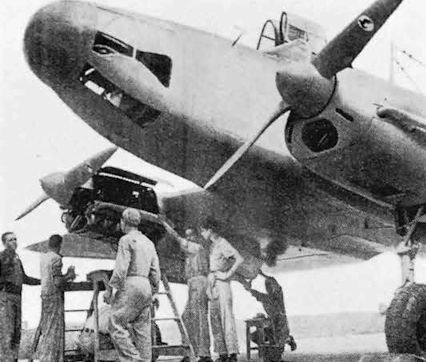
This photo of a Focke-Wulf Fw58 was identified as "the first all-Brazilian-built medium bomber".
F: 12.8.48 p.188 - Aviation in Brazil.
Fabrica do Galeao also licence-built the Focke-Wulf Fw58B (Weihe) bomber/training monoplane (2 Argus 240hp 8-cyl vee AS10C engines) which served Brazilian Naval Aviation from 1938 to 1941. Although these have been said to number 16, the serials were given as D2Fw-147 (delivered), -168 to -177 (assembled) and 2AvN-209 to -223 (built), which totals 26. These were transferred to the Brazilian Air Force as bomber and navigation trainers serving from 1941 to 1950 with serials AT-Fw58-1167 to -1192 (Fw58B) which totals 26 and suggests that all the Navy aircraft survived five years to be handed over to the Air Force, quite remarkable if so. Two others were built as Fw58C, serials UC-Fw58-2654 and -2655. One of the AT-Fw58 aircraft which had seen civilian use post-war as PP-FDE was restored for the Museu Aerospacial.Самолёты на фотографии: Focke-Wulf FW.58 Weihe - Германия - 1935
-
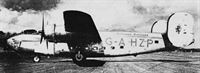
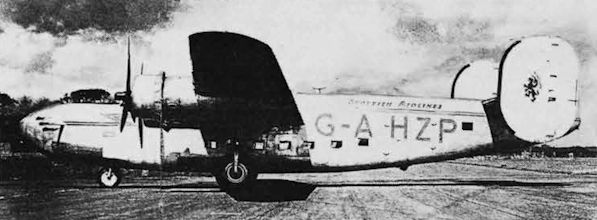
Регистрационный номер: G-AHZP, AL516 LB-30 Liberator G-AHZP of Scottish Airlines with its faired nose and fuselage tail-end and with cabin windows, in which form it was used from Co/A 12.8.46 to its crash at Speke 13.10.48.
Aeroplane October 22nd 1948 *p.542 - Scottish Airlines Liberator, operating on Northern Ireland milk run, crashed on landing at Speke 13.10.48, no injuries.
A: 22.10.48 p.542 - Scottish Airlines Liberator G-AHZP crashed at Speke on 13.10.48 was originally delivered to Dorval, Montreal on 26.9.41, flown to Prestwick and delivered to 150 Sqdn at Snaith in Yorkshire as AL516. It was damaged 3.42 and after repair went to 1653 Heavy Conversion Unit, then back to 150 Sqdn where it was again damaged 7.42. Repaired, it again went to 1653 HCU. After being laid up at Prestwick it was purchased by Scottish Aviation Ltd. (Believed to be c/n 14, it is also quoted elsewhere as c/n 8 AL510 or as c/n 11 AL513.) The aircraft was modified for civil use by fitting a freight compartment in a lengthened nose, converting the bomb bay into a 30-seat passenger cabin and fitting a fuselage tail-end fairing as with others of the LB-30 type. In this case 7 rectangular windows were fitted in each side, though freighter versions did not have them. It was given a CofA 12.8.46 and used on various charters and the Berlin Airlift, continuing until the milk run on which it crashed at Speke. As an LB-30/Liberator II it was distinguishable from later Liberators by the circular engine cowlings with oil cooler intakes in the wing leading edges (S3C4-G/R-1830-33 engines) while later models had the oil cooler intakes in the sides of oval nacelles (S4C4-G/R-1830-65 engines). All Liberators had the P&W Twin Wasp engines of 1000hp (normal), 1200hp (take-off).Самолёты на фотографии: Consolidated C-87/C-109 Liberator Express - США - 1942
-
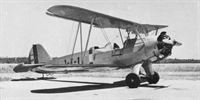
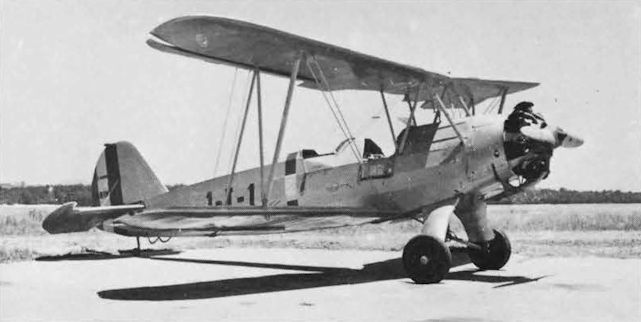
A Focke-Wulf Fw44J of Brazil's Naval School of Training in 1939 with the marks 1-I-1 and MARINA across the rudder stripes of blue/yellow/green, later changed to green/yellow.
F: 12.8.48 p.188 - Aviation in Brazil.
The Fabrica do Galeao built under licence 41 Focke-Wulf Fw44J (Stieglitz) training biplanes (150hp Siemens 7-cyl Sh14 radial engine) numbered I1AvN-126 to I1AvN-166. These were used by the Brazilian Naval Aviation from 1936 to 1941. Two others were built by the Fabrica Militar de Aviones for the Brazilian Army, as numbers 57 and 58, and used from 1938 to 1941, when organisational changes took place. An ex-Argentine Fw44 has been preserved in the Brazilian Museu Aerospacial near Rio de Janeiro.Самолёты на фотографии: Focke-Wulf FW.44 Steiglitz - Германия - 1932
-
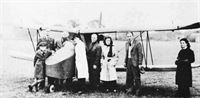
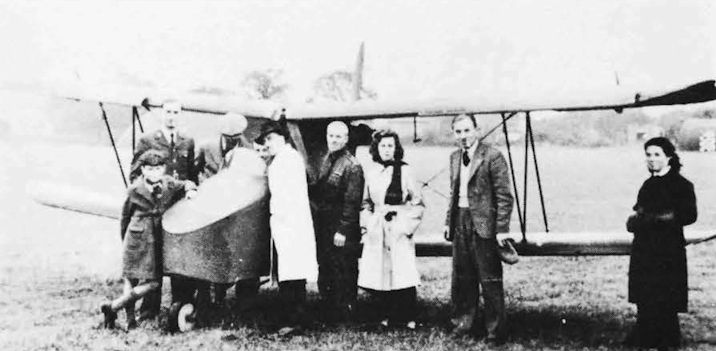
Регистрационный номер: PH-AMG The Scheldemusch PH-AMG at Hockley Heath with Sid Webb in RAF uniform, Don Burgoyne in white coat and Joe Wood behind him. The two young ladies are Joe Wood's daughters.
F: 15.7.48 Ads: Further to the Scheldemusch piece on p.94/79, Alfred Jenks has added some useful data. PH-AMG was advertised for sale in Aeroplane 16.2.45 through W S Shackleton and was purchased by Joe Wood within three weeks as it was recorded in his diaries as present at Knowle Hall Airfield by 10.3.45. It was delivered to Whitley on a Queen Mary trailer and then taken to Knowle on Don Burgoyne's trailer. It was flown by Joe and Don on several occasions but when No.41 Elementary Gliding School moved to Hockley Heath from Knowle, Joe wanted to move "the Duchy" (as he called it) up there. On 30.9.45 with Joe steering it and Sid Webb towing it with his car, they managed to negotiate the five mile trip without incident. The Scheldemusch was flown from Hockley Heath until the Gliding School moved to Honiley in 8.46. It was then stored at the rear of the Woods' garage in Shirley, Solihull until it was given away as previously reported.Самолёты на фотографии: De Schelde Scheldemusch - Нидерланды - 1935
-
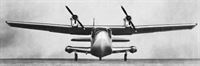
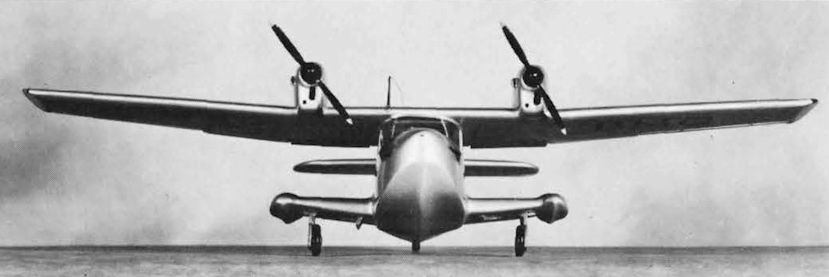
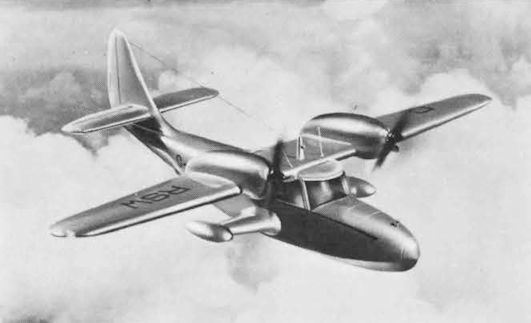
Регистрационный номер: G-ABMQ Frontal view of the Tribian model with a central wheel well aft, perhaps a tailwheel? Under the wing is "registration" G-ABMQ!
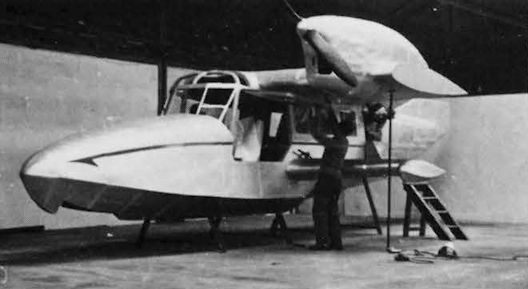
F: 22.7.48 p.108: "Skywriter", the first A-B journal, gave details of the Sponson Developments Tribian under construction by Tiltman Langley. Developed from plans originally by the late J.G.Navarro (either his Naiad or Nereid amphibians?- Ed) it was to be an all-metal 3/4 seater powered by two 145hp Gipsy Major 10s with a land undercarriage retracting into streamlined sponsons which provided added stability on water. A later 5-seat version with 200hp Gipsy Sixes or Blackburn Bombadier engines was also proposed. The builders were attempting to find established companies to set up a production line, even in Norway. (How far did these prototypes progress and what happened to them? - Ed) A later piece, in Flight 29.7.48 p.131, explained that Hon. Simon Warrender met the designer of the Tribian before his death, after which Warrender formed Sponson Developments Ltd with Douglas Reoch to acquire the designs and patents. Rex Stocken joined as technical director and Tiltman Langley were contracted to prepare detailed designs and build the prototype.
F: 22.7.48 p.108 - The Sponson Tribian (see p.94/79) was strongly promoted by Sponson Developments as a model, in illustrations and as a partial mockup. A S A Services, Aircraft Division, were agents and held a display for the aircraft in which they also stated that they held a stock of the Miles Gemini priced at £4230.Самолёты на фотографии: Navarro Naiad - Великобритания - 1947
-
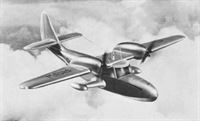
Регистрационный номер: G-DRSW A model of the Sponson Tribian marked G-DRSW, against a cloudscape.
Самолёты на фотографии: Navarro Naiad - Великобритания - 1947
-
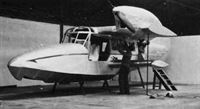
Full-scale partial mockup of the Tribian shows a cutout for a retractable nosewheel, higher sponson and other changes.
Самолёты на фотографии: Navarro Naiad - Великобритания - 1947
-
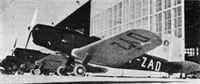
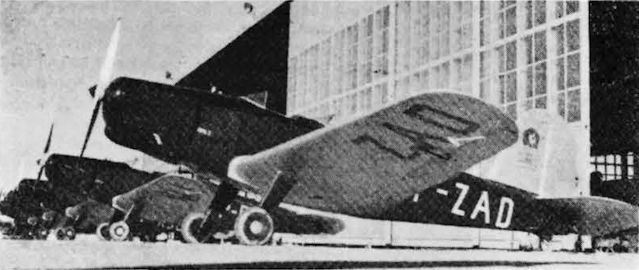
Регистрационный номер: PP-ZAD The HL-6 Caure was built as a standard trainer for Brazilian flying clubs from 1941 and owed much to the licence-built Fairchild Cornell.
F: 12.8.48 p.188 - Aviation in Brazil.
The HL-6B Caure low-wing tandem open-cockpit trainer, first flown in 1941, had the same layout as the Fairchild PT-19A Cornell trainer built under licence, and was no doubt strongly influenced by it. One was produced for the Brazilian Air Force as L-HL6-3053. Its 125hp Lycoming O-290 flat four engine had exposed cylinders but the civil HL-6B, production of which commenced in 1943, had the 130hp O-290-C completely cowled. It was reported that structural failures had occurred in service and no contracts followed after the initial 50 aircraft. Some were modified to have enclosed cockpits and spats on the mainwheel legs. The maximum speed was given as 200 km/hr (124 mph) and cruising speed 170 km/hr (112 mph), initial rate of climb 270 m/mim (886 ft/min), ceiling 5200 m (17,060 ft) and loaded weight 800 kg (1764 lb).Самолёты на фотографии: CNNA HL-6 Caure - Бразилия - 1942
-
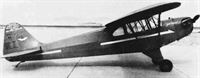
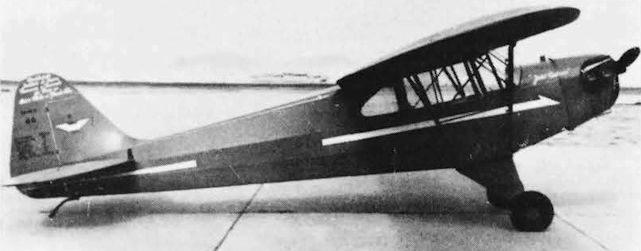
Регистрационный номер: PP-TTQ The HL-1 could only be distinguished from a Piper Cub by the spaced underwing support struts. This appears to be c/n 86 unmarked, if so it later became PP-TTQ.
F: 12.8.48 p.188 - Aviation in Brazil.
The HL-1 produced by the Companhia Nacional de Navegacao Aerea with 65hp Continental A-65 flat four engine was so similar to the Piper J3C-65 Cub that the only apparent difference was the two underwing struts which were attached separately at the bottom instead of as a vee. It was reported that 100 were ordered for the flying clubs and some sources said "over 100 built". The highest c/n that we have recorded is 99 (on PP-TXH), while three Air Force serials L-HL1-3050 to -3052 (ex FAB-01 to -03) are known.Самолёты на фотографии: CNNA HL-1 - Бразилия - 1940
-
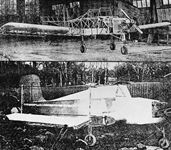
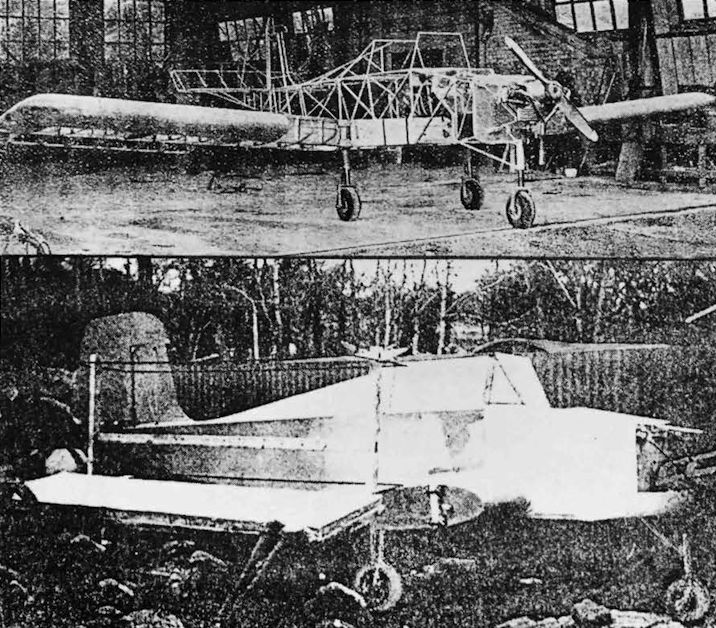
Регистрационный номер: G-ALYA The Hants and Sussex Herald. The upper part shows a Flight photo of the airframe before covering. The lower part shows the Herald discarded without engine but still on its wheels.
Aeroplane May 28th 1948 *p.628 - Good progress was reported by Hants & Sussex Aviation at Felpham on the prototype Herald single-seater. Originally Nuffield powered it was now to use a 40 hp JAP J-99. Designed to ARB aerobatic criteria, it has a regular planform for good stalling characteristics and simplified construction. A low-wing design, with wide track nosewheel landing gear, the fin and rudder are set forward of the horizontal tail surfaces at the end of a long fuselage to improve spinning characteristics.
A: 28.5.48 p.628: The Hants & Sussex Herald G-ALYA, c/n HS/AC/001, made only a few ground hops at Portsmouth in 1953 and was dismantled in 1954.
A: 28.5.48 p. 628 - The Hants & Sussex Herald was not dismantled in 1954 (see p.94/75) as photographs, one of which is dated 9.55, show it minus engine, out of doors and apparently discarded but otherwise still intact. H&S announced that the Herald was intended to be a testbed for a 2-seater to fill the gap in this class in Britain at the time.Самолёты на фотографии: Hants and Sussex Herald - Великобритания - 1953
-
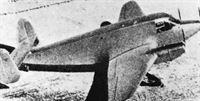
The prototype HL-8 three engine transport was later given passenger windows and trousered undercarriage fairings, but it did not go into production.
F: 12.8.48 p.188 - Aviation in Brazil.
The HL-8 prototype was an 8-10 passenger monoplane with three 125hp Lycoming O-290 engines, twin fins and rudders and a fixed tailwheel undercarriage. It was built in 1944 but did not go into production.Самолёты на фотографии: CNNA HL-8 - Бразилия - 1943
Статьи
- -
- Casualty Compendium (56)
- Extracts
- Feedback
- Malta (VP-M 9H-) /Complete Civil Registers/ (11)
- The de Havilland DH.114 Heron /The Whole Truth/ (2)
- The Fairey Primer /Fact file/ (6)
- The Piper Vagabond /Aircraft Production List/ (6)
- J.Geelen, R.Deerness - New Zealand (ZK-) /Complete Civil Registers/ (3)